
-
 Call: +91-9840269190
-
 Mail: hr@voltechgroup.com

How to hire Employees from India for Overseas roles
Published: August 5, 2025 | Last Updated: May 13, 2026 Author:Srisivam Selvaraj, Sales & Overseas Recruitment Specialist, Voltech HR Services
Key Takeaways
This guide explains, step by step, how employers in the Gulf (UAE, Saudi Arabia, Qatar, Oman, Kuwait, Bahrain), Europe (Germany, Romania, Poland) and Malaysia can legally hire workers from India in 2026. Specifically, you will learn:
All data in this guide is sourced from official government records and industry reports. Sources are cited directly after each claim.
Why are Employers Worldwide Hiring from India right now?
India is the world's largest source of overseas workers by volume. According to the Ministry of External Affairs (MEA), Government of India, approximately 3.5 lakh (350,000) Indian workers were legally deployed abroad through licensed recruitment agents in 2024 - a figure that reflects a 28% reduction in illegal migration, credited to stricter enforcement of the Emigration Act, 1983. (Source: MEA Emigration Data Portal, 2024)
This matters to overseas employers because it signals two things: India has a large, available workforce across skilled and semi-skilled sectors and the Indian government actively monitors and regulates the outflow to protect workers - which means employers who follow proper procedures face far fewer deployment delays and legal disputes.
According to the ManpowerGroup 2025 Talent Shortage Report, 74% of employers globally reported difficulty filling roles - the highest level recorded in more than 17 years. Construction, engineering, healthcare and skilled trades were among the hardest-hit sectors, increasing global demand for skilled Indian professionals.
Is hiring Workers from India legal and What does India require?
Yes, hiring workers from India is fully legal - provided both the Indian recruitment agency and the overseas employer meet specific requirements under the Emigration Act, 1983 (India).
Here is what Indian law requires:
What this means for overseas employers: You cannot simply contact individual workers in India and arrange employment directly. A licensed Indian recruitment agency acts as the legal intermediary between you and the worker - handling emigration clearance, document attestation and pre-departure orientation on your behalf.
What are the Visa and Compliance Rules for Each Hiring Region?
The legal requirements placed on the overseas employer vary significantly by destination country. Below is a region-by-region breakdown.
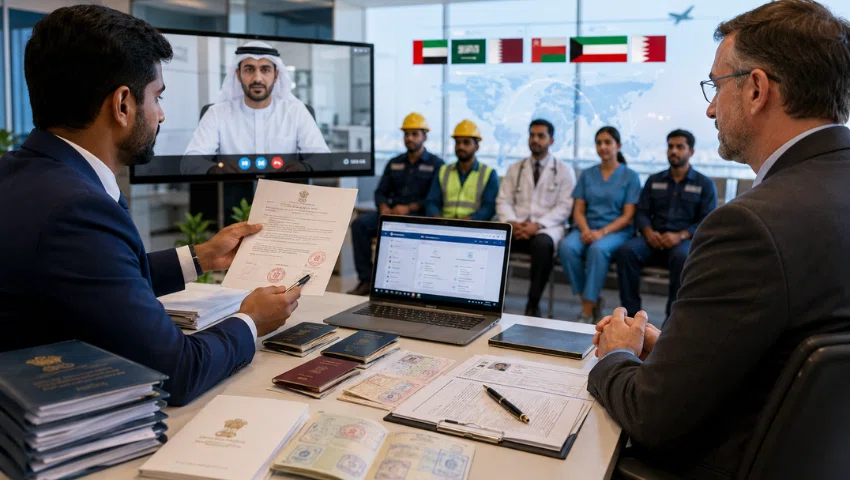
Gulf Cooperation Council (GCC): UAE, Saudi Arabia, Qatar, Oman, Kuwait, Bahrain
GCC countries operate a kafala (sponsorship) system, under which the employer is the legal sponsor of the worker's visa. This creates direct employer liability for the worker's legal status while in-country.
Documents required from the GCC employer: Demand letter (embassy-attested), employment contract (translated into Arabic where required), valid trade licence copy and proof of accommodation for the worker.
European Union: Germany, Romania, Poland
EU member states do not use a kafala system. Instead, they operate points-based or profession-based immigration frameworks.
Documents required from EU employers: Signed employment contract (in the destination country's language plus English), proof of wage compliance with local minimum wage laws and company registration documents.
United Kingdom
The UK operates a Skilled Worker Visa route under its points-based immigration system, introduced post-Brexit.
What Documents are required to Hire an Indian worker abroad?
A successful overseas hire requires two parallel document sets: one from the employer/company and one from the candidate. Missing or unauthenticated documents are the single most common reason for visa rejection in countries including Kuwait, Oman and Germany.
Employer/Company Documents
| Document | Purpose | Authentication Required |
|---|---|---|
| Demand Letter | Formally requests workers from the Indian agency | Embassy/Consulate attestation (India) |
| Employment Contract | Defines role, salary, benefits and duration | Translation if destination language is not English |
| Company Trade Licence | Proves legal business operation | Notarisation in destination country |
| Power of Attorney | Authorises Indian agency to act on behalf of employer | Apostille or Embassy attestation |
Candidate Documents
| Document | Purpose | Authentication Required |
|---|---|---|
| Valid Passport (min. 6 months validity) | Travel and identity | N/A |
| Educational Certificates | Qualifications verification | HRD attestation + MEA + Embassy |
| Experience Letters | Past employment history | Employer letterhead, notarised where required |
| Medical Fitness Certificate | Health clearance for work visa | Issued by GAMCA-approved clinics (for GCC) |
| Police Clearance Certificate | Criminal background check | Home Ministry, state of residence |
What HRD and MEA attestation means: HRD (Human Resource Development) attestation is verification by the state education department that confirms an Indian candidate's degree is genuine. MEA (Ministry of External Affairs) attestation is the central government's counter-verification of that state certification. Both are required before the destination country's embassy will accept the document. Skipping either step results in automatic visa rejection.
How do you verify that an Indian candidate's documents are genuine?
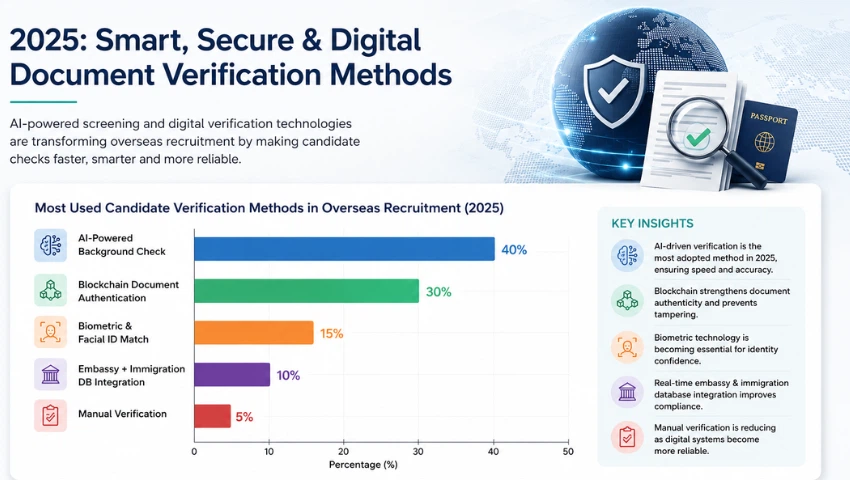
Document fraud is a growing challenge in overseas recruitment. According to the First Advantage 2025 Global Screening Trends Report, more than 30% of international job applicants were found to have submitted falsified or exaggerated credentials.
Attestation alone does not fully eliminate this risk. While attestation confirms that a document is officially recognised, it does not verify whether the candidate genuinely worked for the employer mentioned or possesses the claimed skills and experience.
To reduce hiring risks, a proper overseas background verification process typically includes:
Modern AI-assisted screening tools can also detect altered certificates, manipulated documents and fake experience letters with high accuracy.
A structured background verification and AI-assisted screening are integrated into every overseas recruitment process to help employers reduce fraud risks before deployment.
What is the Step-by-Step process to legally Hire an Employee from India?
The legal overseas hiring process has six sequential steps. These steps are not interchangeable - each requires the previous one to be completed before it can begin.
-
1. Write the Demand Letter
Draft a formal demand letter on company letterhead mentioning job title, vacancies, salary, benefits, working hours and contract duration. The document must be attested by the Indian Embassy or Consulate. -
2. Engage a Licensed Recruitment Agency
Submit the attested demand letter to an MEA-licensed Recruiting Agent (RA) in India for sourcing and screening candidates. -
3. Attest Candidate Documents
Candidate certificates go through HRD → MEA → Embassy attestation before visa processing. -
4. Process Visa and Sponsorship
Submit visa applications with employer and candidate documents to the destination country embassy. -
5. Pre-Departure Orientation
Workers receive briefing about labour laws, rights, safety and cultural expectations. -
6. Deployment and Compliance Tracking
Complete travel coordination, insurance, compliance records and final deployment process.
Typical total timeline: 6 to 12 weeks from demand letter submission to worker arrival at destination, for GCC hires with complete documents. EU hires typically take 10 to 16 weeks due to longer visa processing and qualification recognition steps.
What are the most expensive legal mistakes in Overseas Recruitment?
The following are some of the most common legal violations in overseas recruitment and their serious consequences for employers and recruitment agencies.
-
1. Using an Unlicensed Recruitment Agent in India
The hiring process becomes invalid under the Emigration Act and workers may not receive emigration clearance. Unlicensed agents can face fines of up to INR 5,00,000 along with criminal prosecution. -
2. Sending Workers on Tourist Visas
Workers may be deported and employers can be blacklisted in the destination country. In GCC countries like the UAE, this may also result in work permit restrictions and entry bans. -
3. Issuing False Offer Letters
Providing misleading salary details, job roles or employment conditions can lead to fraud-related legal action under Indian law and create liability for both the employer and recruitment agency. -
3. Deploying Workers Without Insurance
Employers become fully responsible for medical expenses, workplace accidents, compensation and repatriation costs. In many GCC countries, valid worker insurance is mandatory for visa approval.
What should you look for in a Licensed Overseas Recruitment Agency in India?
A reliable overseas recruitment agency in India should meet the following standards before you engage them:
Frequently Asked Questions
Q1: How long does it take to hire an employee from India for a Gulf country?
For GCC destinations with complete documents, the full process - from demand letter to worker arrival - takes 6 to 12 weeks. Incomplete attestation is the most common cause of delays.
Q2: Can I hire Indian workers without using a recruitment agency?
For ECR-category workers going to GCC countries, using a licensed Indian recruitment agency is legally required under the Emigration Act, 1983. For non-ECR workers or EU destinations, direct hire is legally possible but operationally complex - the employer must manage all attestation and emigration documentation independently.
Q3: Is background verification necessary if the candidate's documents are attested?
Yes. Attestation confirms physical document authenticity. It does not verify employment history accuracy, qualification legitimacy, or criminal background. Both processes serve different purposes and both are required for compliant overseas hiring.
Q4: What countries does Voltech HR Services recruit for?
Voltech HR Services currently recruits for UAE, Saudi Arabia, Qatar, Oman, Kuwait, Bahrain, Germany, Romania, Poland and Malaysia. All recruitment is conducted under MEA and MOIA licensing.
Q5: What does Voltech HR Services provide beyond candidate sourcing?
Voltech manages end-to-end visa processing, HRD/MEA/Embassy attestation, AI-assisted background verification, pre-departure orientation, travel coordination, worker insurance arrangement and post-deployment compliance tracking. Voltech is trusted by 500+ companies across the Middle East, Europe and Asia.
Related Resources for Employers & HR Leaders
Looking to strengthen your international hiring strategy and workforce operations? Explore our in-depth recruitment and manpower guides:
→ How to Legally Hire Workers from India & the Philippines for Germany - Learn the legal recruitment process for hiring international workers for Germany, including visa pathways, documentation requirements, compliance procedures and overseas workforce onboarding strategies for employers.
→ Brunei Labor Shortage Guide for Employers - Explore the growing labour shortage challenges in Brunei across construction, hospitality, engineering and industrial sectors. Understand how overseas recruitment and workforce planning help businesses meet manpower demand.
→ Why European Companies Need Indian Talent for Future Recruitment - Discover why European employers increasingly hire Indian professionals across IT, healthcare, engineering, logistics, manufacturing and skilled trade sectors to address long-term workforce shortages and demographic challenges.
Conclusion: Hire from India Legally and Confidently
Hiring employees from India for overseas roles is a structured process that involves legal compliance, document verification, visa procedures and proper workforce screening. When handled correctly, it helps employers access skilled talent efficiently while reducing operational and compliance risks.
From demand letter processing and document attestation to background verification and deployment support, every stage plays an important role in successful overseas hiring. Working with an experienced and MEA-licensed recruitment partner can help employers simplify the process, avoid costly mistakes and ensure smoother international workforce deployment.
Author's Bio:
Hi, I’m Srisivam Selvaraj from Voltech HR Services. I’ve written this guide based on my 10+ years of experience working in international business development and overseas recruitment, especially across GCC countries like Saudi Arabia. Over the years, I've closely worked with employers, recruitment processes, document compliance and overseas workforce requirements in sectors such as HVAC, industrial supply and building materials. Through this blog, I wanted to share practical insights that can help employers understand the legal hiring process from India more clearly and avoid common recruitment mistakes.
📞 Need help? Feel free to reach out to me at +91 - 89398 37019 or email: srisivam.s@voltechgroup.com
Subscribe for latest update

Write Comment