
-
 Call: +91-9840269190
-
 Mail: hr@voltechgroup.com

Brunei's Labor Shortage in Construction & Hospitality - What Business Owners Should Do Now

- By srisivam Selvarajan
- Published: March 02 2025 | Reading Time: ~12 minutes
Quick Verdict: Why Reactive Overseas Hiring Fails in Brunei
Overseas hiring in Brunei fails not because workers are unavailable, but because businesses hire reactively without planning for the 7-21 day work permit process and the 3-6 month recruitment cycle. The real breakdown occurs between identifying manpower needs and getting workers fully approved and deployed on-site.
Companies that depend on urgent, unplanned hiring face delays, compliance risks and higher costs. Those that build structured, advance recruitment pipelines with licensed partners secure faster approvals, better retention and lower per-hire expenses.
The issue is not talent supply - countries like India, the Philippines, Bangladesh and Indonesia have deep skilled and unskilled labour pools. The real problem is the absence of early, compliance-driven manpower planning.
Key Takeaways:
• 83% of Brunei’s construction workforce is foreign - the highest of any sector. (Labour Dept, April 2024)
• Accommodation & Food Services has 11,361 foreign workers, making up 63% of the sector. (Labour Dept, April 2024)
• Brunei’s total registered foreign workforce peaked at 75,402 in 2023, reflecting post-COVID recovery demand.
• Vision 2035 has flagged construction, tourism and hospitality as priority growth sectors - meaning manpower demand will increase, not decrease.
• Indian workers are a strong, structured and growing source of both skilled and unskilled manpower for Brunei companies.
• Using licensed overseas recruitment services reduces legal risk, speeds up hiring and ensures worker readiness.
• The government’s fast-track special approval can cut your work permit waiting time from 21 days to 7 days.
• Retention is as important as recruitment. Reducing turnover directly reduces your manpower costs.
Brunei Labor Shortage: What Business Owners Should Do Now
As of April 2024, 83% of Brunei's construction workforce and 63% of its hospitality workforce are made up of foreign workers. (Source: Brunei Labour Department, April 2024) These numbers exist for one reason: there are not enough local workers available to fill private sector roles in these two industries. If you run a construction company or a hospitality business in Brunei and you are struggling to find workers, this is the structural reality behind that problem and it is not going to resolve itself without a deliberate hiring strategy.
You are not alone. This is one of the most common challenges that Brunei business owners in the private sector face today. The good news? There are clear, practical steps you can take right now and understanding the bigger picture is the first step.
This guide breaks down why the labor shortage is happening, how it is specifically hitting construction and hospitality, where reliable workers are actually coming from and what smart business owners are doing about it.
What Does the Data Actually Say About Brunei’s Manpower Need?
Here is how the current landscape looks, based on official data about the Brunei manpower need across key industries.
| Sector | Foreign Workers (2024) | % of Workforce That Is Foreign | Source |
|---|---|---|---|
| Construction | 21,515 | 83% | Brunei Labour Dept, April 2024 |
| Accommodation & Food Services | 11,361 | 63% | Brunei Labour Dept, April 2024 |
| Agriculture & Fisheries | 3,521 | 75% | Brunei Labour Dept, April 2024 |
| Retail Sector | 8,350 foreign vs 6,001 local | Majority foreign | LegCo Session, March 2025 |
| Total Foreign Workers in Brunei (2023 peak) | 75,402 | ~25% of total labour force | Ministry of Home Affairs, 2024 |
Sources: Brunei Labour Department (April 2024), Ministry of Home Affairs - 21st Legislative Council (LegCo) Session, March 2025; U.S. State Dept. 2024 Investment Climate Statement for Brunei.
The following figures from official Brunei government sources confirm the structural scale of foreign worker dependency across key private sectors:
• Construction alone relies on foreign workers for 83 out of every 100 jobs on site.
• The accommodation and food services sector (hotels, restaurants, cafes) has 11,361 foreign workers making up 63% of its workforce.
• The total number of registered foreign workers in Brunei grew from 65,579 in 2019 to a peak of 75,402 in 2023 - a 15% increase in just four years.
• (Source: Minister of Home Affairs, Brunei - 21st Legislative Council Session, March 2025; Borneo Bulletin, March 6, 2025) This is not a post-COVID spike that will correct itself. It is a structural trend. Brunei's private sector has become increasingly dependent on overseas manpower to function, and that dependency is deepening - not shrinking. For business owners in construction and hospitality, this means overseas recruitment is not a backup plan. It is the primary workforce strategy.
Why Construction Businesses in Brunei Struggle Most to Find Workers
Construction is where Brunei’s manpower gap is most visible. And if you are a contractor, developer or project manager, you already feel this every single day.
Four structural factors explain why Brunei's construction sector faces a persistent and worsening shortage of local workers:
• Local workers, particularly those with higher education, actively avoid physically demanding, outdoor construction roles in favour of government or office-based jobs.
• Brunei’s Vision 2035 is pushing major infrastructure development - roads, housing, commercial buildings, and government facilities - which is increasing demand for construction labour faster than supply can keep up.
• Work permit and quota systems, while necessary for governance, create administrative bottlenecks and delays that slow down hiring timelines significantly.
• High turnover: construction workers on two-year renewable contracts frequently return home, meaning the cycle of recruitment never really ends.
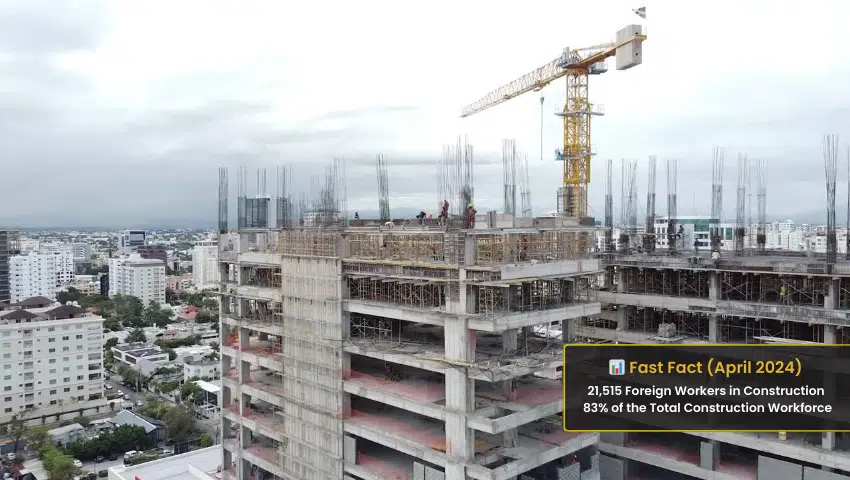
📊 Fast Fact: As of April 2024, construction accounts for 21,515 foreign workers - more than any other sector in Brunei. That is 83% of the entire construction workforce. (Source: Brunei Labour Department, April 2024)
What Roles Are Most Needed on Construction Sites in Brunei?
The most in-demand construction roles in Brunei are general labourers, masons, electricians, plumbers and civil engineers - the majority sourced from India, Bangladesh, and the Philippines due to the absence of sufficient locally-trained tradespeople.
| Role Type | Typical Origin of Workers | Skill Level |
|---|---|---|
| General labourers | Bangladesh, India, Indonesia | Unskilled |
| Masons, bricklayers, plasterers | India, Bangladesh | Semi-skilled |
| Electricians, plumbers | India, Philippines | Skilled |
| Welders, fabricators | India, Philippines | Skilled |
| Civil engineers, site supervisors | India, Philippines, Malaysia | Highly Skilled |
| Scaffolders, riggers | Bangladesh, India | Semi-skilled |
Skilled and unskilled employees for Brunei from countries like India, Bangladesh, the Philippines and Indonesia have filled this gap. Particularly, Indians for Brunei companies have become a reliable source of both skilled trades workers - such as electricians, welders and engineers and semi-skilled construction labour, given India’s large, experienced and technically trained workforce.
How the Labor Shortage Is Hitting Hospitality & F&B Businesses
Brunei's accommodation and food services sector employed 11,361 foreign workers in April 2024, making up 63% of the sector's total workforce - the second-highest foreign worker dependency ratio of any industry in Brunei. (Source: Brunei Labour Department, April 2024) Despite this already high reliance on overseas manpower, hospitality and F&B business owners consistently report that finding and retaining enough workers remains their most pressing operational challenge. The following section explains the four reasons why this sector is hit harder than most.
Why Hospitality Owners Feel This Pain More Acutely
• High staff turnover is structurally built into the industry. Shift work, weekend hours and physically demanding roles mean workers leave frequently.
• Brunei’s Wawasan (Vision) 2035 has officially identified tourism and hospitality as one of five national priority sectors for economic diversification, meaning more hotels, restaurants, and tourism businesses are coming - adding even more demand for workers. (Source: AMRO Asia, 2024)
• The government signed an MOU with Timor-Leste in November 2023 specifically to bring in hospitality workers, highlighting how seriously this shortage is being taken at a national level.
• Globally, the World Travel & Tourism Council (WTTC) projects a shortfall of 8.6 million hospitality workers by 2035. (Source: WTTC Future of the Travel & Tourism Workforce Report, October 2025) Here is what this means specifically for Brunei business owners: the countries that currently supply the majority of Brunei's hospitality workforce - India, the Philippines and Indonesia - are the same countries that hotels, restaurants and resorts across the Gulf, Europe and East Asia are also competing for. As global demand for these workers rises, so does competition for them. Brunei businesses that build early, structured relationships with licensed overseas recruitment agencies will secure better workers faster. Those that wait will face longer timelines, higher costs and a smaller available talent pool.
🏨 Did You Know? In 2024, Brunei’s accommodation and food services sector employed 11,361 foreign workers, representing 63% of its total workforce.
Source: Brunei Labour Department, April 2024
What Roles Are Most in Demand in Hospitality & F&B?
The hardest-to-fill hospitality roles in Brunei include kitchen helpers, cooks, wait staff and housekeeping staff - predominantly sourced from India, the Philippines, Indonesia and Bangladesh.
| Role | Difficulty to Fill Locally | Common Source Countries |
|---|---|---|
| Kitchen helpers, dishwashers | Very High | Bangladesh, India, Nepal |
| Cooks & Line Chefs | High | India, Sri Lanka, Nepal |
| Waitstaff & F&B attendants | High | Philippines, Indonesia, India |
| Hotel front desk & housekeeping | Medium-High | Philippines, India |
| Restaurant managers / supervisors | Medium | India, Philippines, Malaysia |
| Baristas, cashiers | High (turnover) | Indonesia, Philippines |
Sources: U.S. State Dept. 2024 Country Reports on Human Rights Practices: Brunei; WTTC Workforce Report, October 2025.
Where Are Reliable Workers Actually Coming From? The Role of Overseas Recruitment
As of 2024, Brunei's private sector sourced its foreign workforce primarily from Bangladesh (~26,000 workers), Indonesia (~25,000), and the Philippines (~23,000), with India representing a growing source particularly for skilled construction and hospitality roles. (Source: U.S. State Department, 2024 Trafficking in Persons Report: Brunei)
Here is how the current landscape looks, based on official data:
| Country of Origin | Approx. Number in Brunei | Primary Sectors |
|---|---|---|
| Bangladesh | ~26,000 | Construction, Agriculture |
| Indonesia | ~25,000 | Domestic work, Semi-skilled roles |
| Philippines | ~23,000 | Domestic, Hospitality, Skilled roles |
| India | Growing presence | Construction (skilled/semi-skilled), Hospitality, Oil & Gas |
Source: U.S. State Dept. 2024 Trafficking in Persons Report: Brunei (for worker nationality data).
India is an increasingly common manpower source for Brunei construction and hospitality companies. The demand for Indians for Brunei companies is growing for four specific, verifiable reasons - each of which directly addresses the practical gaps that Brunei employers face when hiring:
• Technical training and certifications (ITI, polytechnic, engineering degrees)
• English language proficiency - which is crucial in hospitality, client-facing and supervisory roles
• Experience across Gulf, Southeast Asian, and East Asian markets - making them globally work-ready
• Availability across both skilled and unskilled categories for Brunei - from site engineers down to general laborers and kitchen helpers.
🇮🇳 India’s Workforce Advantage: Recruitment agencies registered with India's Ministry of External Affairs (MEA) are legally required to follow a structured deployment process for every overseas placement.
This includes employer demand letter verification, trade testing, medical screening, visa processing and pre-departure orientation.
For Brunei employers, MEA registration is not just a quality signal - it is legal protection.
Source: HR International, India Overseas Recruitment Guide
When you work with a licensed overseas recruitment service for Brunei, they handle the entire backend: candidate sourcing, skill verification, documentation, work permit coordination, and deployment. This removes an enormous administrative burden from your shoulders and ensures you get workers who are genuinely ready to contribute from day one.
What Should Brunei Business Owners Do Right Now? 6 Practical Steps
The following six actions are the most practical and immediately implementable steps that Brunei construction and hospitality business owners can take to address their manpower shortage - based on how Brunei's work permit system operates and how overseas recruitment actually works on the ground:
1. Stop Relying Only on Walk-In or Word-of-Mouth Hiring
In a tight labour market, passive hiring does not work. If you are waiting for workers to come to you, your competitors who are actively recruiting will always be ahead. Start proactively connecting with licensed overseas recruitment channels that specialise in your sector.
2. Plan Your Manpower Needs 3 to 6 Months in Advance
Work permit and quota approval in Brunei takes approximately 21 days through standard processing channels. (Source: U.S. State Department, 2024 Investment Climate Statement for Brunei) A fast-track special approval option exists that reduces this to 7 days for qualifying businesses - particularly restaurants and new retail operations. This timeline is fixed by government process, not by your recruitment agency, which is why planning your manpower needs 3 to 6 months ahead of your actual requirement date is not optional - it is the only way to avoid project delays and understaffed operations.
3. Use the Special Approval Fast-Track for New Hires
If you are a newer business or have an urgent hiring need, Brunei’s government offers a special approval mechanism that cuts the standard quota waiting time from 21 days to 7 days for select categories including restaurants and retail stores. (Source: U.S. State Dept. 2024 Investment Climate Statement for Brunei). Speak to your recruitment partner about how to qualify.
4. Explore Indian Manpower Sources Specifically
If you need manpower for your Brunei company from India, this is one of the most practical decisions you can make in 2025. Indian workers are well-documented, MEA-registered, pre-screened, and available across a wide range of roles. Whether you need a site engineer, a head chef, a welder or a kitchen helper, India has a deep talent pool in all of these areas. The structured recruitment process also means less risk of contract issues or worker abandonment.
5. Do Not Compromise on Documentation and Compliance
One of the biggest risks businesses face when hiring overseas is cutting corners on documentation to save time or cost. This creates serious legal exposure. Ensure that every worker you bring in has a valid work permit, a clear employment contract, and that their recruitment was handled by a licensed agency registered with the relevant authorities in their home country.
6. Build a Retention Strategy, Not Just a Recruitment Strategy
It costs significantly more to recruit a new worker than to retain an existing one. For construction, this means providing reasonable accommodation, timely wages and safe working conditions. For hospitality, it means consistent scheduling, recognition and clear paths to responsibility. Workers who feel treated fairly stay longer, refer others and save you the constant cycle of re-hiring.
What Is Brunei’s Government Doing About the Labour Shortage?
It is worth knowing what is happening at the policy level, because these decisions directly affect how and when you can hire.
| Initiative | What It Means for You |
|---|---|
| Minimum Wage Roll-Out (from July 2023) | Started in banking & ICT; construction and domestic workers were planned next. Watch for updates as this affects your wage budgeting. |
| Long-Term Pass for Skilled Workers | Brunei introduced a Long-Term Pass to attract and retain skilled foreign professionals - good news if you are hiring technical roles. |
| Brunei Tourism Industry Roadmap 2024–2035 | More hotels and tourism businesses coming online means even higher demand for hospitality workers ahead. |
| MPEC’s 60 Critical Occupations List | The Manpower Planning & Employment Council (MPEC) has identified 60 critical occupations across energy, construction, ICT, hospitality and logistics - a signal of where the government acknowledges the most urgent workforce gaps. |
| MOU with Timor-Leste (Nov 2023) | A government-to-government agreement to recruit hospitality workers, reflecting the scale of the hospitality sector’s manpower need. |
Sources: Borneo Bulletin Year Book 2024; AMRO Asia Consultation Report 2023; Ministry of Home Affairs, Brunei; Borneo Bulletin Online, March 2025.
Frequently Asked Questions
These are the questions Brunei business owners ask most often when dealing with the manpower shortage.
Q1: How do I legally hire foreign workers for my Brunei construction business?
You need to apply for a work quota through Brunei’s Labour Department, then secure individual work permits via the Immigration Department. The standard processing time is around 21 days, though a fast-track option (7 days) exists for qualifying new businesses. Working with a licensed overseas recruitment agency simplifies this process significantly, as they handle documentation, visa coordination and compliance on your behalf.
Q2: Can I hire Indians for my Brunei company specifically?
Yes and it is increasingly common. Indian recruitment agencies registered with India’s Ministry of External Affairs supply workers across construction, hospitality, engineering, and more. The process includes trade testing, medical screening, documentation, and pre-departure orientation. Both skilled professionals (engineers, chefs, IT staff) and unskilled workers (labourers, kitchen helpers, cleaners) are available.
Q3: What types of skilled and unskilled employees can I get from overseas for Brunei?
For construction: civil engineers, electricians, plumbers, welders, masons, scaffolders, general labourers. For hospitality: head chefs, line cooks, kitchen helpers, waitstaff, housekeeping, front desk agents and restaurant supervisors. Most overseas recruitment agencies have pre-screened talent pools ready for deployment once permits are secured.
Q4: How long does it take to bring in workers from overseas?
Once the work quota and permit are approved (7–21 days), overseas recruitment agencies typically take 4–8 weeks to source, screen, document and deploy workers. Planning your manpower needs 3–6 months in advance is strongly recommended, especially for project-based work in construction.
Q5: What is the biggest mistake Brunei business owners make when hiring foreign workers?
Hiring urgently without proper documentation and compliance checks. Cutting corners to save time often results in legal penalties, deportation of workers, or loss of your work quota allocation. Always use licensed recruitment channels and ensure every worker has a valid, verified contract and work permit.
Q6: Is there a government fast-track for work permits in Brunei?
Yes. Brunei’s government offers a special approval mechanism for qualifying businesses - particularly restaurants and retail stores - that reduces the standard 21-day quota processing time to 7 days. This is only available for a limited period (up to six months for new businesses).
Conclusion: The Shortage Is Real. The Solutions Are Available.

As a business owner in Brunei, the labor shortage is not something that is going to solve itself. The structural reasons behind it - local preference for government jobs, growing private sector demand driven by Vision 2035, and the physically demanding nature of construction and hospitality work - are deep-rooted. But that does not mean you are stuck.
Brunei construction and hospitality businesses that consistently fill their manpower needs - without project delays or constant re-hiring - share four specific practices:
1. Advance planning (3 to 6 months ahead) - Reduces vacancy downtime and avoids the premium costs that come with urgent, last-minute recruitment.
2. Licensed overseas recruitment partnerships - Reduces legal compliance risk, documentation errors, and the administrative burden of managing work permit applications independently.
3. Sourcing from structured manpower countries - Recruiting from countries with formal overseas employment frameworks, such as India (MEA) and the Philippines (POEA), reduces the risk of contract violations, worker abandonment and permit cancellations.
4. Active retention strategies - Reducing annual worker turnover by even 20% directly cuts your recruitment costs, minimises project disruption and builds a more experienced, stable on-site team.
Whether you need manpower for your Brunei company for a single project or on an ongoing basis, the right overseas recruitment partner can make the entire process straightforward - from sourcing to deployment to compliance. The key is to start early and work with people who genuinely understand the Brunei market.
If you are exploring your options for overseas recruitment services for Brunei, Voltech HR Services is a recruitment and manpower services firm with deep expertise in connecting businesses with the right talent - both skilled and unskilled - from trusted source countries. Reach out to learn how they can support your specific hiring needs.
Related Resources for Brunei Employers & HR Decision-Makers
Looking to secure reliable overseas manpower and build a compliant workforce pipeline for your Brunei operations? Explore our strategic recruitment insights:
→ Skills-First Hiring for Overseas Recruitment Success
Discover why competency-based hiring is transforming international recruitment. Learn how structured skill evaluation, trade testing, and role-based screening improve deployment quality, reduce attrition and ensure long-term workforce stability for construction and hospitality sectors in Brunei.
→ Why European Companies Need Indian Talent in Future Recruitment
Understand the global demand shift toward Indian skilled and semi-skilled professionals. Explore why structured sourcing from India offers reliability, compliance transparency and scalable workforce solutions - a model equally relevant for Brunei’s growing construction and hospitality needs.
→ How Can I Hire Foreign Workers from India Legally?
A complete guide for employers seeking legally compliant overseas hiring. Learn about MEA-registered recruitment agencies, documentation standards, visa processing, medical clearances, employer demand letter verification and structured deployment processes that protect Brunei businesses from compliance risks.
→ Decline in Indian Manpower for Middle East Jobs - What It Means for Employers
Analyze the changing migration landscape and its impact on workforce supply. Understand how shifting demand patterns create both risks and strategic opportunities for Brunei employers seeking stable, long-term manpower partnerships.
Author's Bio:
Hi, I'm Srisivam Selvarajan, Overseas Recruitment General Manager at VHRS with 10+ years of experience in international manpower supply across Pan-Asia. [ Connect with me on LinkedIn ]
Over the past decade, I've worked with employers across construction, hospitality, oil and gas, and facilities management - helping them source the right workers from India, the Philippines, Bangladesh, Nepal, Sri Lanka and Indonesia.
I've seen what works and what doesn't when it comes to overseas manpower. This article is based on that experience, backed by verified data from Brunei's Labour Department, the U.S. State Department and international workforce reports.
Subscribe for latest update

Write Comment