
-
 Call: +91-9840269190
-
 Mail: hr@voltechgroup.com

Can I Check If a Job Candidate Has a Criminal Record?

Can I Check If a Job Candidate Has a Criminal Record?
- By Jagannathan.M, General Manager - BGV Services
- August 10, 2026
TL;DR: Yes - employers can legally check a job candidate's criminal record in India, but only with the candidate's written, standalone consent, through authorised sources like court records (e-Courts/JUDIS) and local police verification. India has no single national criminal database, so most checks combine an online court search with physical police verification. A criminal record should never trigger automatic rejection - it must be weighed against the role's risk profile before any hiring decision is made.
Introduction: The Question Every Hiring Manager Eventually Asks
Every HR manager eventually asks the same question after a great interview: "This candidate looks perfect on paper - but do we actually know who we're hiring?" A criminal background check is how you answer that question with evidence instead of a gut feeling. According to background verification cases processed across Indian industries, roughly 2 in every 100 criminal checks surface a record or red flag that the candidate never disclosed - a small percentage that can carry an outsized cost if it lands in a role involving cash, data, vehicles, or vulnerable people.
It's also one of the most misunderstood parts of the hiring process. Employers either skip it entirely out of uncertainty about the law, or run it carelessly without proper consent and expose the business to compliance risk. This guide walks you through both sides - what's legally permitted, and exactly how to do it properly in 2026.
Can Employers Legally Check a Candidate's Criminal Record Before Hiring?
Yes. In India, there is no law that prohibits an employer from checking a candidate's criminal history - but there's also no single law that makes it mandatory for every employer and every role. Instead, criminal background verification sits at the intersection of a few legal frameworks:
📌 Right to Privacy (Article 21) - The Supreme Court's 2017 K.S. Puttaswamy judgment confirmed privacy as a fundamental right, which is exactly why candidate consent is non-negotiable rather than optional.
📌 IT Act, 2000 & SPDI Rules, 2011 - Govern how sensitive personal data, including criminal records, must be collected, stored and secured.
📌 Digital Personal Data Protection (DPDP) Act, 2023 - Classifies employers running background checks as "Data Fiduciaries," with binding obligations around consent, purpose limitation and data retention.
📌 Sector-specific regulation - RBI/SEBI (banking & finance), IRDAI (insurance), MCI (healthcare) and the POCSO Act (any role with access to children) make criminal verification effectively mandatory in those sectors.
👉 In practice: you can check a candidate's criminal record for any role, as long as you have their consent and use an authorised, verifiable source. What you cannot do is pull a criminal record without consent, rely on an unauthorised or unofficial channel, or reject a candidate automatically without weighing whether the finding is relevant to the job.
📖 Related deep dive: For the full legal breakdown - including 2025 DPDP Rules, consent form requirements and the penalty structure - read our detailed guide: DPDP Rules 2025 & Criminal Background Checks in India
Make Background Verification Part of Your Hiring Process
Protect your workplace with reliable, consent-based criminal background verification designed for compliant hiring.
Talk to Our BGV TeamWhy Do Criminal Background Checks Matter Before Hiring?
A resume tells you what a candidate says about themselves. A criminal background check tells you what the public record says. For most businesses, that gap matters more than it seems - a single bad hire in a role with access to cash, data, vehicles, or vulnerable people can cost far more than the price of verification.
1. Workplace Safety - Employees interact with colleagues, clients and sometimes the public. Screening reduces the risk of workplace violence, harassment or repeat offences.
2. Financial & Data Protection - Roles with access to company funds, customer data or systems carry higher fraud exposure if a candidate has an undisclosed history of financial crime.
3. Reputational Protection - A hire linked to a criminal case after joining can damage client trust and employer brand, especially for client-facing or B2B service roles.
4. Legal Due Diligence - Indian courts increasingly recognise "negligent hiring" claims, where an employer is held liable for harm caused by an employee whose adverse record was discoverable but never checked. A documented criminal check is your evidence of due diligence.
5. Regulatory Compliance - In regulated sectors, skipping the check isn't a shortcut. It's a compliance gap that surfaces at the next audit.
What Information Actually Shows Up in a Criminal Background Check?
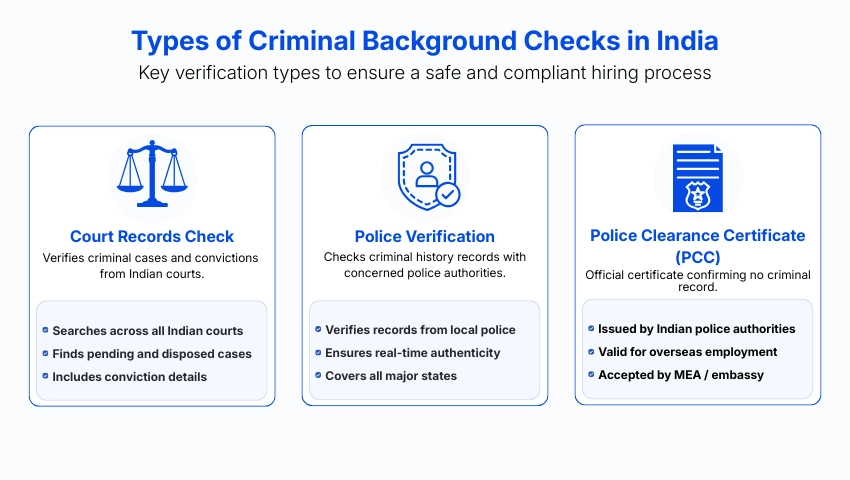
India does not have one centralised, searchable criminal database like the US NCIC or the UK's DBS system. Criminal records are maintained locally across roughly 15,000 police stations, which is why a thorough check usually combines more than one method:
🔎 Court Record Check (e-Courts / JUDIS) - Scans civil and criminal cases across 3,000+ district, sessions and high courts. Fastest and least expensive option, completing in 2-5 days, but only captures cases that reached court.
🔎 Police Verification (Physical) - A field agent contacts the candidate's local police station directly. Surfaces FIRs, pending investigations and adverse records not yet in court. Slower at 7-15 days, but more thorough.
🔎 Police Clearance Certificate (PCC) - A formal "no adverse record" certificate from the Police Commissioner or SP. Used for government roles, visas and high-security positions. Takes 15-30 days.
🔎 Global Watchlist / Sanctions Check - Screens Interpol, UN and OFAC lists. Common for BFSI and MNC hiring. Fastest turnaround at 1-2 days.
👉 Typically surfaces: convictions (theft, fraud, assault, cybercrime), pending FIRs and ongoing trials, and civil litigation involving the candidate.
👉 Typically does not surface: juvenile records (legally protected), cases resolved out of court, most acquittals, and records from jurisdictions that were never searched - which is exactly why disclosing every city a candidate has lived in matters.
Do You Need the Candidate's Consent and What Does Valid Consent Look Like?
Yes - always. Consent is the single most important compliance step in the entire process, and it's also the step employers get wrong most often. A vague line in the offer letter saying "we may conduct background verification" is no longer sufficient under current data protection standards. Valid consent needs to be:
1️⃣ Specific - names the exact checks being run (e.g., "criminal record check via court records and police verification"), not a generic catch-all.
2️⃣ Informed - the candidate knows what data is collected, why, and who processes it, including any third-party BGV vendor.
3️⃣ Freely Given - it can't be buried inside the offer letter as a take-it-or-leave-it clause.
4️⃣ Standalone - issued as its own document, not bundled with other employment terms.
5️⃣ Revocable - the candidate can withdraw it, though withdrawal doesn't obligate you to make an offer.
📌 Pro tip: Collect only what's needed for the check itself - full name, date of birth, current and previous addresses, and a government ID (Aadhaar or PAN). Requesting unrelated sensitive data (medical history, religion, marital status) without a documented, role-specific reason creates unnecessary compliance exposure.
Which Industries Can't Afford to Skip Criminal Verification?
While criminal checks aren't universally mandatory, they're effectively non-negotiable in certain sectors:
🏦 Banking, Financial Services & Insurance (BFSI) - RBI, SEBI and IRDAI guidelines require exhaustive screening, including financial integrity and sanctions checks.
🏥 Healthcare - MCI regulations and patient-safety obligations make criminal history checks standard for clinical and support staff.
🏫 Education & Childcare - The POCSO Act mandates criminal checks for anyone in direct or indirect contact with minors - teachers, admin staff and even school transport drivers.
🚚 Logistics, Field Sales & Delivery - Roles involving vehicle access, cash handling or unsupervised customer visits carry elevated risk without verification.
💻 IT & ITES with Global Clients - ISO 27001-certified companies and MNC vendor contracts often mandate documented BGV, including criminal checks, as a contractual requirement.
🏛️ Government Contractors - Screening is typically required under the relevant ministry's guidelines.
Common Misconceptions About Criminal Background Checks
❌ "We can just Google the candidate's name."
A search engine result isn't a verified record, and
acting on unverified information exposes you to defamation and wrongful-rejection risk. Criminal checks must come from
authorised sources - court databases, police verification, or a licensed BGV agency.
❌ "Any criminal record means automatic rejection."
Not under Indian employment practice. Blanket
disqualification policies create legal exposure. The nature of the offence, how long ago it occurred, and its relevance to
the specific role should all factor into the decision.
❌ "Once the offer letter mentions background checks, we're covered."
A generic clause bundled into
an offer letter doesn't meet current consent standards. Consent needs to be its own document, specific to the checks being run.
❌ "Our background check vendor is responsible for compliance."
Outsourcing the check doesn't
outsource the liability. The employer remains legally responsible for how the vendor handles candidate data, which is why
a signed data processing agreement with any BGV vendor matters.
Best Practices for Employers Running Criminal Background Checks
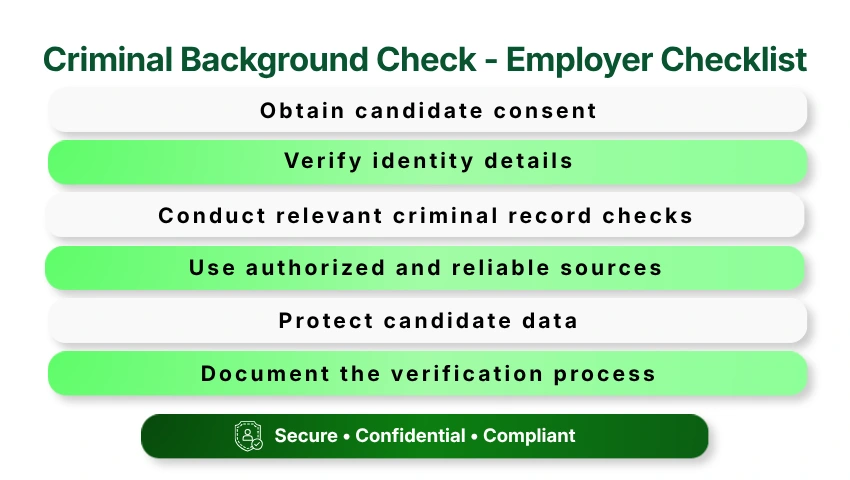
1. Define the scope by role risk. A finance controller and a data-entry executive don't need the same depth of check - document which roles require which checks, and why.
2. Get standalone, specific consent before initiating anything - never rely on a clause buried in the offer letter.
3. Use authorised sources only - e-Courts/JUDIS records, police verification, or a licensed BGV partner. Skip informal or unofficial searches.
4. Partner with a compliant BGV vendor and have a written data processing agreement in place covering security, retention and breach notification.
5. Evaluate findings individually - weigh severity, recency and job relevance rather than applying a blanket rule.
6. Give candidates the right to respond if a finding could affect the offer, especially since name-matching errors in decentralised records do happen.
7. Set a data retention and deletion policy - don't hold onto rejected candidates' reports indefinitely.
8. Extend the same process to contractors and gig workers, not just full-time employees.
Why Choose Voltech HR Services for Criminal Background Verification?
✅ Over 5 million background verification cases completed across IT, BFSI, healthcare and manufacturing.
✅ Authorised court record and police verification network across India's 15,000+ police jurisdictions.
✅ ISO 27001:2022 & ISO 9001:2015 certified data handling processes.
✅ DPDP-compliant, standalone consent workflows built for the 2025 Rules.
🎯 Checking a candidate's criminal record isn't just legally permitted - for many roles, it's a basic risk-management step that protects your team, your data and your reputation. Partner with Voltech HR Services for reliable, compliant Background Verification solutions.
Need help with compliant background verification?
Talk to our Background Verification team about the right screening process for your organization.
Frequently Asked Questions
1. Is it legal to ask a candidate about their criminal history during an interview?
Yes, you can ask, but the answer should be verified through a formal check rather than taken at face value. Self-disclosure alone isn't a substitute for verification, and undisclosed findings should be discussed with the candidate before any adverse decision.
2. How long does a criminal background check take in India?
A court records check typically takes 2-5 days. Physical police verification takes 7-15 days, and a formal Police Clearance Certificate can take 15-30 days, depending on the jurisdiction.
3. Can I reject a candidate solely because of a criminal record?
You can, but it should be a considered decision, not an automatic one. Factor in how serious the offence was, how long ago it happened, and whether it's actually relevant to the job - and give the candidate a chance to respond before finalising the decision.
4. Do startups and small businesses need to run criminal checks too?
There's no legal size threshold that exempts smaller employers. If you're hiring for roles involving cash, data, client access or vehicles, the risk exposure is the same regardless of company size - only the scale of your BGV program should differ.
5. What happens if a candidate refuses consent for a background check?
You cannot proceed with the check without consent. You can, however, make consent to legitimate, role-relevant verification a standard condition of the hiring process, and decide how to proceed with candidates who decline.
Author's Bio:
Hi, I'm Jagannathan.M, General Manager - BGV Services at Voltech HR Services, with over 10 years of experience in Indian data protection law, employment regulation and HR compliance. I've overseen criminal background verification for clients across IT, BFSI, healthcare and manufacturing, and my goal is to help employers build hiring processes that are both legally sound and genuinely safer for their workplace.
Need help with Background Verification?
Speak with our team about building a reliable and compliant screening process for your organization.
Contact us: +91 98402 69190 | hr@voltechgroup.com
Subscribe for latest update

Write Comment