
-
 Call: +91-9840269190
-
 Mail: hr@voltechgroup.com

Can Criminal Record Verification Protect the Business From Hiring Risks?

Can Criminal Record Verification Protect the Business From Hiring Risks?
- By Voltech HR Services - Background Verification Practice
- Published: 12 July 2026
TL;DR
Yes - criminal record verification measurably reduces hiring risk. It screens a candidate against court and police records before an offer is finalized, giving the employer documented proof of reasonable care and a defensible position against negligent-hiring claims. In India, this runs as a focused four-step process - candidate consent, court record verification, local police verification where applicable and quality review and reporting - distinct from a Police Clearance Certificate (PCC), which is a government-issued document for visa and immigration purposes. This guide covers exactly how the process works, how it differs from a PCC, and what employers should watch for before making a hiring decision.
Key Takeaways:
• Under the Digital Personal Data Protection (DPDP) Rules, 2025, employers must obtain explicit candidate consent, collect only role-relevant criminal history and maintain a documented audit trail before running any check.
Hiring the wrong person can affect far more than day-to-day operations. A single poor hiring decision can lead to financial loss, legal disputes, damage to customer trust, workplace safety incidents or exposure of confidential business information. This is why employers no longer treat interviews and resumes as sufficient on their own and increasingly treat criminal background verification as a standard part of responsible hiring.
Most organizations do not introduce criminal verification without a specific trigger. In practice, the decision is usually driven by one of the following:
- A major client requires proof of employee criminal verification before allowing staff onto a project.
- An internal compliance audit identifies a gap in recruitment procedures.
- A previous hiring mistake resulted in theft, fraud, workplace misconduct or a security incident.
- A regulator in a licensed sector (banking, healthcare, aviation) mandates stronger employee screening.
- An insurance provider recommends criminal verification as a condition of coverage.
- The business is expanding into a regulated industry where screening becomes mandatory.
- The role involves handling cash, vulnerable individuals or sensitive customer data.
Criminal verification is not about assuming a candidate is dishonest. It is about giving the employer documented proof of reasonable care before placing someone in a position of trust - the exact standard courts and regulators look for when a hiring decision is later questioned. Even an experienced recruiter cannot identify every risk from an interview alone; a structured criminal record check adds a layer of due diligence that interviews and references cannot replicate.
Why criminal verification checks matter in India
Interviews and resumes only show what a candidate chooses to reveal. Criminal verification checks court and police records to confirm what an employer actually needs to know before extending trust.
It's now standard practice - accounting for nearly 40% of global screening requests, with 45 million+ checks run annually in India. Skipping it doesn't just raise risk; it weakens the employer's position if something goes wrong later.
It matters most in roles involving cash, client access, vulnerable individuals, or sensitive data - where one bad hire can become a legal, financial or reputational problem fast.
And the math is simple: a check costs a few hundred rupees. Replacing a bad hire can cost lakhs. Criminal verification isn't about assuming guilt - it's documented proof that an employer took reasonable care before making an offer.
The Business Case, in Numbers
| Metric | Data Point | Why It Matters to an Employer |
|---|---|---|
| Share of global screening requests that are criminal checks | ~40% of global screening service volume | Criminal background verification represents a significant share of global screening requests, demonstrating its widespread adoption as a standard hiring and risk management practice. |
| Annual criminal and employment background checks conducted in India | 45 million+ | Establishes the scale at which Indian employers already treat criminal screening as routine practice. |
Sources: Gloroots India employer guide (2026), HireRight 2021 Global Benchmark Report, Multiplier India background check guide.
How Do Companies Perform Criminal Background Checks on New Hires in India?
Companies in India verify a candidate's criminal history by searching court and police records through a structured, four-step process. India does not maintain one centralized national database that returns a complete criminal record on its own - records sit across district courts, sessions courts, High Courts and individual police jurisdictions - so a compliant criminal verification always combines multiple trusted sources rather than a single lookup.
Step 1 - Candidate Consent
Before any search begins, the employer or its BGV partner obtains explicit, written consent from the candidate. Consent protects candidate privacy, satisfies India's data protection rules and sets out exactly what will be checked, why and how long the data will be retained.
This is a non-negotiable first step, not a formality - running a criminal check without documented consent is itself a compliance failure, independent of what the check finds. Under the DPDP Rules, 2025, consent must be informed, specific to the role and kept on file as part of the recruitment record.
Step 2 - Court Record Verification
Court record verification is the core of the criminal background verification process. Verification specialists search relevant District Courts, Sessions Courts, High Courts and publicly available judicial records to identify any criminal cases associated with the candidate. Depending on the nature of the role and applicable employer policies, searches may cover an appropriate historical period to provide a comprehensive view of the candidate's criminal record. Any findings are carefully reviewed to ensure they accurately reflect the current legal status of the case before being included in the final report.
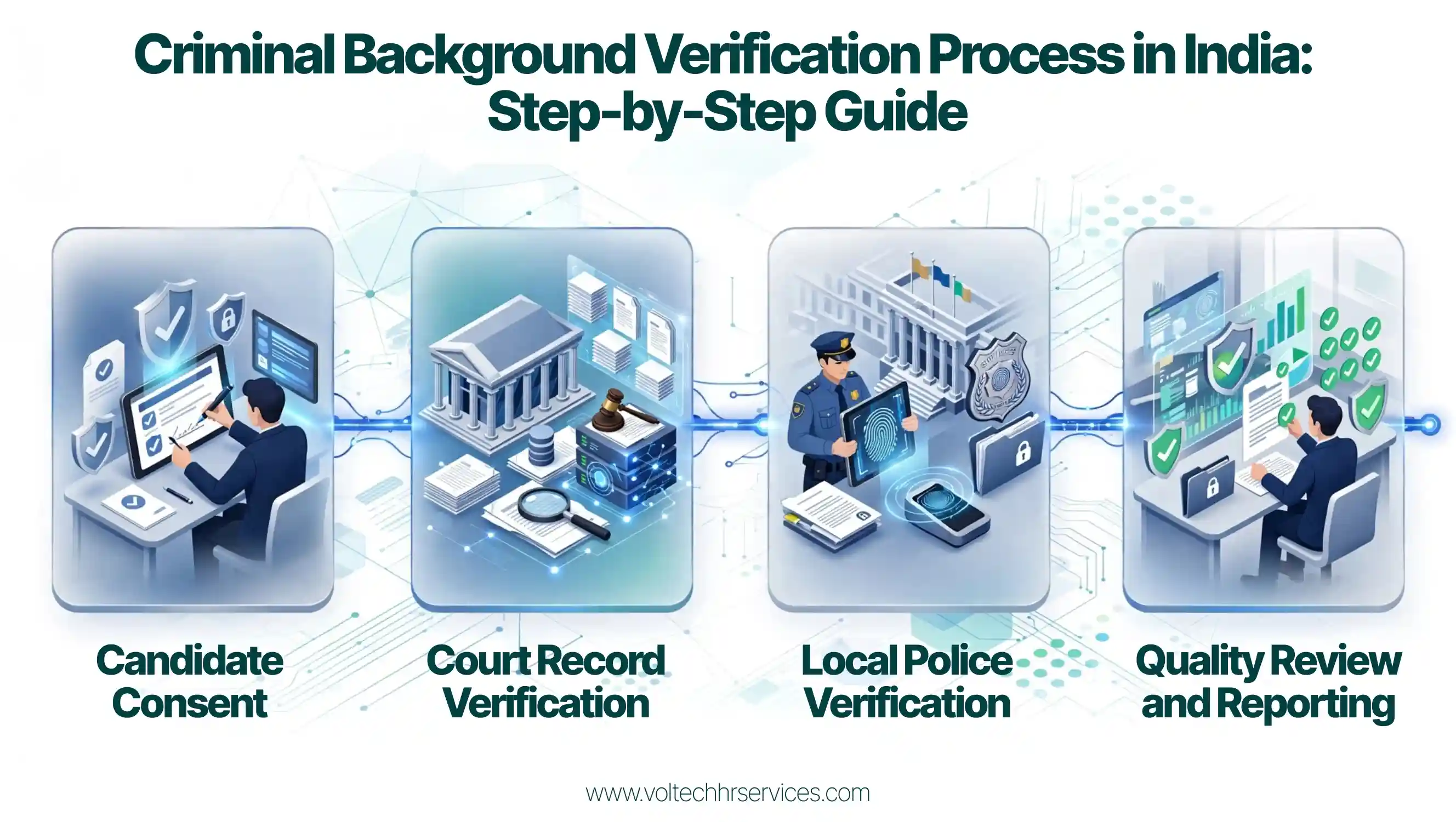
Step 3 - Local Police Verification (Where Applicable)
For positions involving higher levels of responsibility or public trust, employers may require local police verification where legally permitted. This is commonly considered for roles involving cash handling, security services, transportation, customer site visits or work with vulnerable individuals. Local police verification provides an additional level of assurance alongside court record verification and is generally conducted only when required by the nature of the role, client requirements or industry regulations.
Step 4 - Quality Review and Reporting
Findings are reviewed for accuracy before a final report is issued, classifying the outcome as clear, discrepant (a match requiring employer judgment) or inconclusive (insufficient records to confirm either way). The verification company does not decide whether to hire the candidate - the report is an input and the hiring decision always remains with the employer.
A flagged record is verified for accuracy by checking its current legal status, not just whether a case exists:
- Check case status, not just case existence - a pending case, a closed case and an acquittal are materially different outcomes. Treating "a case exists" as equivalent to a conviction risks both an unfair rejection and a discrimination exposure for the employer.
- Request the primary source document for any discrepant finding - the original court order or FIR copy - rather than acting on a database summary alone. Digitized records can lag behind actual court outcomes by months.
- Give the candidate a right to respond. Candidates should be informed of an adverse finding and given the opportunity to clarify or dispute it before a final decision is made.
- Re-verify time-sensitive records. A check completed at the start of a long hiring process can be 60–90 days old by the offer stage; re-running it before onboarding is standard practice for finance, healthcare and security-sensitive roles.
Typical turnaround: most criminal verification checks in India complete within 5–10 working days through an established BGV partner with pan-India court and police coordination. Manual, self-run checks by an internal HR team routinely take 3–4 weeks, largely due to jurisdiction-hopping between courts and follow-up delays with police stations. Turnaround also depends on the number of court jurisdictions involved and the availability of judicial records in those jurisdictions.
Criminal Verification vs. Police Clearance Certificate (PCC)
A Police Clearance Certificate (PCC) is a government-issued document obtained through the Ministry of External Affairs' Passport Seva portal, and it serves a different purpose from an employer-run criminal verification check. Business owners frequently confuse the two, so the distinction is worth stating plainly.
| Criminal Verification | Police Clearance Certificate (PCC) | |
|---|---|---|
| Conducted by | Employer or an accredited verification agency | Government authority (Ministry of External Affairs) |
| Used for | Hiring decisions within India | Immigration, overseas employment, long-term visas, residency |
| Sources searched | Court records and, where applicable, local police records | Police clearance status only |
| Who receives the output | The employer receives a verification report | The individual receives an official certificate |
A PCC is required specifically for employment abroad, long-term visas, residency status or immigration - it cannot be issued for tourist visas and it is not what an employer uses to screen a candidate for a domestic role.
The PCC process, briefly: apply online via the Passport Seva portal → book a PSK appointment and pay the ₹500 government fee (non-refundable) → attend the appointment with passport, address proof and supporting documents, where biometrics are captured → the application is forwarded for local police verification → the certificate is issued and downloadable from the applicant's account once the police report is received. Processing typically takes 7 - 30 days and the certificate is valid for 6 months from issue for most receiving countries. Employers recruiting for roles within India generally rely on their own criminal verification process rather than requesting a PCC, unless a specific role involves relocation, immigration sponsorship or a client contract explicitly requires one.
Common Challenges During Criminal Verification
Even a well-run criminal verification process runs into a few recurring, practical challenges. Employers who understand them are better placed to interpret a report correctly.
- Similar Names - Many individuals in India share common names, which can increase the possibility of matching the wrong person. To ensure accuracy, verification teams carefully review the information available in court records and supporting legal documents before confirming that a record belongs to the candidate.
- Multiple jurisdictions - Candidates frequently relocate for education and employment. Someone who has lived in Chennai, Bengaluru and Pune over the past several years may require separate court searches in each city, which adds time and coordination.
- Incomplete or non-digitized records - Not every court proceeding is available in a searchable public database. Many district courts still rely partly on physical filings, so a verification partner with established on-ground relationships can surface records a database-only search would miss.
- Pending cases vs. convictions - A pending investigation is not the same as a completed conviction. Acquitted, dismissed and withdrawn cases should never be treated the same as a confirmed conviction - this distinction should always be visible in the final report, not left for the employer to infer.
Best Practices for Employers Running Criminal Verification
- Obtain written consent before verification begins and keep it documented as part of the recruitment file. Running a check without documented, informed consent exposes the employer to breach-of-contract and data-privacy claims, independent of whatever the check finds.
- Limit checks to what's role-relevant. Under the DPDP Rules 2025 and India's data-minimization expectations, employers may only request criminal history relevant to the specific job - a broad request for unrelated litigation history doesn't meet the "necessity" standard.
- Use an accredited, experienced verification partner rather than an ad-hoc internal process - court procedures, documentation standards and jurisdictional coverage require specialized expertise.
- Evaluate results fairly, not automatically. Weigh job responsibilities, the severity of any finding, time elapsed and current legal status before making a decision. A criminal record is treated as a protected category under Indian employment principles and blanket rejection without individualized, role-relevant assessment can itself create legal exposure.
- Don't overlook contractors and gig staff. Indian courts have repeatedly extended vicarious liability to companies for a contractor, gig worker or agency staff member working on their premises, even when a third-party vendor is the employer on record. Screening contract and gig staff - with the same consent standards - is now considered good practice.
- Maintain confidentiality. Verification reports contain sensitive personal data; access should be limited strictly to authorized HR and compliance personnel.
Industries That Benefit Most From Criminal Verification
Every employer can benefit from screening, but criminal verification carries outsized value in sectors involving elevated trust, safety or regulatory oversight: Banking and Financial Services, Healthcare, Pharmaceuticals, Information Technology, Manufacturing, Oil & Gas, Construction, Logistics, Education, Aviation, Hospitality, Security Services, Retail, Government Projects and BPO/Shared Services.
The Business Value of Criminal Verification Beyond Compliance
Business owners often weigh the cost of a criminal verification check against the cost of skipping it as if they were comparable line items. They are not.
| Scenario | Typical Cost |
|---|---|
| Standard criminal verification check (per candidate, through an accredited BGV partner) | A few hundred to a couple of thousand rupees, depending on jurisdiction depth and role sensitivity |
| Cost of replacing a bad hire (recruitment, onboarding, lost productivity, retraining) | Can run into several lakhs of rupees per role, depending on seniority and time-to-productivity |
| Employee-related fraud losses reported across Indian businesses | Estimated at several thousand crore rupees annually across sectors, per VHRS's ongoing analysis of internal-fraud disclosures |
Beyond the direct cost comparison, a well-run criminal verification process is a strategic investment in organizational resilience. It helps businesses strengthen hiring confidence, reduce workplace risk, protect company assets, safeguard customer trust, support regulatory compliance and reduce negligent-hiring exposure. Forward-thinking organizations treat it as a component of enterprise risk management, not an administrative checkbox.
Frequently Asked Questions
Q1. Does a clean criminal record check guarantee an employee will never cause harm?
No. A clean check confirms no matched record exists at the time of verification; it does not predict future behavior. It reduces foreseeable risk by removing candidates with a documented history relevant to the role - the legal standard courts apply is reasonable care, not certainty.
Q2. Can an employer reject a candidate solely because of a past criminal record?
Generally, no. Indian employment principles require the record to be assessed against the specific job's duties and risk profile rather than applied as an automatic disqualifier. A conviction unrelated to the role, especially an old or minor one, is unlikely to justify rejection on its own.
Q3. How far back does a criminal record check typically go in India?
Most standard criminal verification checks cover a seven-year lookback across the relevant court jurisdictions, although employers in regulated or safety-sensitive sectors may require a longer review period based on internal policies and compliance requirements.
Q4. Is criminal verification required by law for every job in India?
No. It is not universally mandatory, but it becomes effectively mandatory in regulated sectors (banking, insurance, aviation, healthcare) through sector-specific rules and is strongly recommended for any role involving cash, vulnerable populations or client premises access.
Q5. Can a company run criminal checks on contractors and gig workers, not just full-time employees?
Yes, provided the same consent and data-minimization rules apply. Given that courts have extended vicarious liability to companies for contractor misconduct on their premises, screening contractors and gig staff is now considered good practice.
Related Resources from VHRS
Want to go deeper on consent workflows and data retention timelines under the new rules? Explore our dedicated guide:
→ Criminal Background Checks India: DPDP Guide 2026 - a deeper walkthrough of consent workflows, data retention timelines and DPDP Rules 2025 compliance for employers running criminal checks in India.
Bottom Line for Business Owners
Criminal record verification does not eliminate hiring risk, but it converts an unknown liability into a documented, defensible decision built on court and police records. For an Indian business owner weighing a few hundred rupees per check against the legal exposure and reputational damage of a bad hire, the calculation is not close. The remaining decision is operational: whether to build this capability in-house - which requires jurisdictional expertise across India's fragmented court and police systems - or route it through an accredited partner that already has that infrastructure and the ISO-certified data handling process the DPDP Rules 2025 now expect.
This article is based on publicly available Indian government guidance (Ministry of External Affairs, Passport Seva), the DPDP Rules 2025 and industry research from Gloroots, HireRight and Multiplier, alongside VHRS's own operational experience serving 500+ corporate clients across banking, IT, BFSI, manufacturing, healthcare, oil & gas and construction since 2010. It is intended as general guidance for business owners and does not constitute legal advice; employers should consult qualified legal counsel for role- and sector-specific compliance requirements.
Ready to Build Criminal Verification Into Your Hiring Process?
Voltech HR Services runs pan-India court and police verification with a 5–10 day turnaround, ISO-certified data handling and DPDP Rules 2025-aligned consent workflows - as one process instead of a patchwork of manual checks.
www.voltechhrservices.comCriminal Background Verification | Court Record Verification | Police Verification | DPDP-Compliant Screening | Pan-India Coverage
Write Comment