
-
 Call: +91-9840269190
-
 Mail: hr@voltechgroup.com

Why Your Hiring is slow and How BGV Automation fixes it
- Written by Jagannathan.M , General Manager - BGV Services | Voltech HR Services 10+ years in Indian data protection law, employment regulation and HR compliance.
Published: March 20, 2026 | Reading Time: 18–20 Minutes
Quick Verdict: Why Your Hiring is slow and How BGV Automation fixes it
Manual background verification in India takes 15 to 21 working days on average and that waiting period is the single biggest reason companies lose candidates after making an offer. This guide breaks down exactly why BGV slows your hiring down, how automation cuts that turnaround to under 7 days, and what to look for in a BGV partner that delivers speed without compromising accuracy or DPDP Act compliance.
Key Compliance: BGV Automation in India
The following facts summarise the core findings of this article on background verification automation for Indian employers:
• Manual BGV in India takes 15 to 21 working days. Automated BGV reduces this to 7 to 9 days, with digital-only checks completing in 24 to 72 hours.
• 17% of white-collar resumes in India contain credential mismatches and 13% of employment checks flag fabricated experience, based on a 2025 industry report.
• Consent-based digital verification is a legal requirement under India's DPDP Act.
• A bad hire costs up to one-third of that employee's first-year salary - automated BGV reduces this risk by catching misrepresentations that manual checks miss.
Introduction: The Hidden Cost of Slow Hiring
Every extra day your hiring takes is costing you real money.
You post a job. You get candidates. You shortlist someone good. Then the offer goes out and background verification begins. Suddenly 10, 12, sometimes 15 days pass. Your candidate is waiting. They are getting calls from other companies. And then one morning, you get that message: "I've accepted another offer."
Candidate drop-offs during the BGV waiting period are a documented pattern across Indian hiring, particularly in IT, BFSI and pharma sectors where candidates manage multiple offer pipelines simultaneously.
The delay is rarely about the interview process. It is almost always the background verification stage that slows everything down.
A bad hire costs up to one-third of that employee's annual salary. So slow BGV that lets a wrong hire slip through is not just an inconvenience - it is a direct financial risk.
In this article, we break down why hiring gets stuck, where BGV automation genuinely helps and what to look for in a BGV partner if you are running a business in India.
Why Is Your Hiring Process So Slow?
The five most common causes of slow hiring in India are manual background verification processes, delayed candidate document collection, absence of real-time status tracking, dependency on multiple uncoordinated BGV vendors and misalignment between HR teams and verification teams. Each of these causes is explained in detail below.
1. Manual Background Verification Processes
Someone on your HR team is sending emails to colleges and previous employers. They are waiting for replies. Following up. Chasing documents. Then re-entering data into a spreadsheet. This is a perfectly normal process - it is just extremely slow.
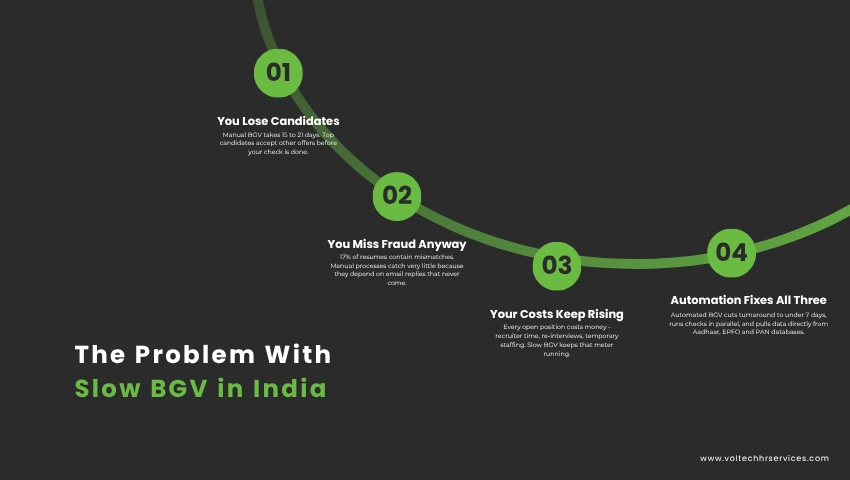
Traditional BGV in India takes 15 to 21 days when done manually and that is when everything goes smoothly.
2. Delayed Candidate Document Collection
You send a form. The candidate fills part of it. You follow up. They send something missing. You follow up again. This back-and-forth alone can eat up 3 to 5 days before any verification even begins.
3. No Real-Time Status Tracking
HR sends documents to a BGV vendor and then waits. There is no dashboard, no live status, no alerts. You have no idea where the employee background check stands unless you call or email.
4. Too Many Vendors, Too Little Coordination
Many mid-sized companies in India use different vendors for different checks - one for address verification, another for education, another for criminal records. Managing these simultaneously with no single point of visibility is chaotic. Delays in one check hold up the entire report.
5. HR and Verification Teams Not Aligned
HR wants to close the offer fast. The verification team is following a process with fixed timelines. These two are often not talking to each other until something goes wrong. That communication gap adds unnecessary days to every hire.
The Real Business Impact of Delayed BGV
Delayed BGV creates four measurable business impacts: offer drop-offs, talent loss to competitors, project delays, and increased cost-per-hire. Each is covered below.
Offer Drop-Offs and Candidate Ghosting
A strong candidate - especially in IT, BFSI or pharma - is rarely talking to just you. If your BGV takes two weeks and a competitor completes onboarding in five days, you have already lost. The candidate does not always formally decline either. They just go silent.
You Lose Good People to Competitors
Top talent does not wait. This is especially true in tech and financial services where demand is high. Every day your BGV drags is a day your competitor is gaining ground. The candidate you waited 18 days for might already be working for someone else on day 10.
Project Delays and Revenue Impact
If you needed that person for a project that was supposed to start on the 1st, a two-week BGV delay pushes everything. For client-facing work, that is not just an internal inconvenience - it can affect deliverables, relationships and billing.
Real example from EY India: A global MNC found that high BGV turnaround times were directly delaying the deployment of billable projects. Once they streamlined BGV, they were able to complete 47% of verifications before the employee's joining date - cutting project delays significantly.
Increased Hiring Costs
The longer a position stays open, the more it costs - job postings, recruiter time, re-interviewing if a candidate backs out, temporary staffing if needed. Slow BGV keeps that cost meter running.
Does Faster BGV Mean Higher Risk? Speed vs Safety Explained
When automation replaces manual processes, accuracy typically improves because checks run against live digital databases rather than relying on email replies from colleges and employers. Here is why this matters.
Why Companies Fear Faster BGV Equals Higher Risk
The instinct makes sense. If you rush, you might miss a fake degree or an undisclosed termination. And the data on resume fraud in India shows that this risk is real - not imagined.
What a 2025 pre-employment screening industry report found about resume fraud in India:
• 17% of white-collar resumes contained mismatches.
• 13% of employment checks flagged fake experience or inflated salaries.
• 5% of employees in tech were found moonlighting.
• In IT/ITES, nearly 1 in 5 candidates misrepresented their profile.
According to EY India's pre-employment screening research, 32% of IT sector candidates submitted employment documents from companies that could not be verified as legitimate entities.
The fear of missing fraud is not paranoia. It is backed by data.
But here is the part most people miss - this fraud is not being caught by slow manual processes either. A BGV that takes 18 days and relies on email replies from HR departments and college registrars is not catching these discrepancies. Most of it slips through anyway.
The difference automation makes is not in being slower or more careful. It is in checking smarter.
The Myth: Slower Means More Thorough
A 15-day manual BGV process does not automatically mean a more accurate one. Think about what that process actually involves - someone on your team sending emails, waiting for replies that may never come, re-entering data by hand and hoping nothing was missed. That is not thoroughness. That is just delay.
Speed and accuracy are not in conflict in automated BGV because the system pulls data directly from authoritative digital sources - Aadhaar, EPFO, PAN databases - rather than relying on human-mediated email exchanges. The accuracy comes from the source, not the speed of the process.
A manual process is slow because it is human. An automated process is fast because it is direct. Those are two very different things.
What Is BGV Automation?
BGV automation - also called automated employee screening - means replacing manual, email-based verification steps with digital workflows that run employee background checks automatically, faster, with less human intervention and with real-time visibility
Here is how a manual process compares to an automated one:
| Manual BGV | Automated BGV |
|---|---|
| Candidate fills physical/email form | Candidate gets a digital self-service link |
| HR chases documents via email | Documents collected in one go via guided portal |
| Checks done one by one (sequential) | All checks run simultaneously (parallel) |
| Status updates: call the vendor | Live dashboard with real-time status |
| Turnaround: 15–21 days | Turnaround: 2–7 days (depending on checks) |
| Risk of data entry errors | Direct API pulls from verified databases |
How BGV Automation Speeds Up Hiring
If you want to know how to speed up background verification without cutting corners, the answer is parallel digital workflows - faster document collection, simultaneous checks and live tracking that removes the waiting entirely. Here is how each piece works.
Instant Data Collection via Digital Forms
Instead of sending a PDF or email form and chasing the candidate, automated platforms send a guided digital link. The candidate fills it in on their phone. If something is missing, they get an instant prompt - not a follow-up email three days later.
Document collection that used to take 3 to 5 days often completes in hours. That alone cuts nearly a week off your hiring timeline before any verification has even started.
Aadhaar Background Verification and Database Checks
Aadhaar e-KYC verification through digital APIs typically completes in under 2 minutes. PAN validation and EPFO employment checks follow the same pattern - what used to take days of email follow-up now returns results the same day.
What used to require someone to manually contact UIDAI or NSDL portals now happens automatically in the background. No waiting. No chasing. No re-entering data by hand.
Parallel Verification Processes
This is the single biggest time-saver in automated BGV and the one most companies do not realise they are missing.
In a manual process, checks run one after another. You finish identity before starting education. You finish education before starting employment. Each check waits for the previous one to close. In an automated system, all three run at the same time. If each check takes 2 days, parallel processing gets you a complete report in 2 days - not 6. That is not a small improvement. That is the difference between a candidate who stays and a candidate who accepts another offer.
Parallel Verification Processes
This is the single biggest time-saver in automated BGV and the one most companies do not realise they are missing.
In a manual process, checks run one after another. You finish identity before starting education. You finish education before starting employment. Each check waits for the previous one to close. In an automated system, all three run at the same time. If each check takes 2 days, parallel processing gets you a complete report in 2 days - not 6. That is not a small improvement. That is the difference between a candidate who stays and a candidate who accepts another offer.
Real-Time Tracking Dashboards
Without a tracking dashboard, HR has no visibility until the final report lands - which means no way to flag delays, chase missing documents, or update hiring managers on where things stand. Most teams work around this by calling the vendor. That call takes time. The answer is often vague.
A real-time dashboard changes this entirely. HR can see which checks are complete, which are pending, and which need attention - all from a single interface, without a single call to the vendor.
How Long Does BGV Take in India - Manual vs Automated?
• Traditional manual BGV in India: 15 to 21 working days.
• Automated BGV platforms in India complete standard verifications in 7 to 9 working days on average.
• Digital-only checks including Aadhaar identity, PAN validation and EPFO employment history can complete in 24 to 72 hours.
These BGV turnaround time figures are based on published SLA benchmarks from Millow BGV and sector research by Dcode Research, covering the Indian pre-employment screening market in 2024-2025.
If you are hiring 50 people a month, cutting 10 days per hire changes your entire onboarding pipeline.
ROI of BGV Automation: Is It Worth It?
Yes. For most companies running more than 10 hires per month, a fast background check for hiring pays for itself within the first quarter - through HR time savings, reduced offer drop-offs and lower bad-hire risk. Here is how the numbers break down.
Time Saved Translates Directly to Cost Saved
Think about how much HR time goes into chasing candidates for documents, following up with vendors and manually updating trackers. Automation removes most of that. Your HR team can focus on actual hiring decisions instead of admin follow-ups.
Reduced Hiring Risks and the Costs That Come With Them
A bad hire is expensive. Industry research puts the cost at up to one-third of that employee's first-year salary. For a role paying ₹10 lakh per year, that is potentially ₹3 lakh+ in wasted costs. Automated BGV with proper fraud detection catches discrepancies that manual checks often miss - especially fake documents and employment misrepresentation.
Compliance Is Built In, Not Added On
India's DPDP Act requires that background verification be done with proper candidate consent and secure data handling. Automated BGV platforms are designed with consent-based workflows built in - so you are compliant from day one without your HR team managing it separately.
How Automated Employee Screening Maintains Accuracy and Compliance
BGV automation maintains accuracy through four mechanisms: elimination of manual data entry errors, standardised verification workflows, consent-based DPDP Act background check compliance and encrypted data handling under ISO 27001 protocols.
Fewer Human Errors
Manual data entry is where mistakes happen. A name spelled slightly differently, a date entered wrong or a document filed in the wrong folder can cause delays or missed flags. Automation pulls directly from databases, removing the human handoff.
Standardised Verification Workflows
Every candidate goes through the same process. No variation based on which HR person is running the check that day. This consistency means fewer gaps and more reliable reports.
Consent-Based and DPDP Act Background Check Compliance
Good BGV automation platforms capture digital consent from candidates before any check is run. This is not just good practice - it is a legal requirement under India's DPDP Act. The platform handles this automatically so you do not have to manage it separately.
Secure Data Handling
Look for BGV providers with ISO 27001 certification. This means candidate data is encrypted, access is controlled, and your company's data practices can withstand scrutiny - important if you are in BFSI, healthcare, or any regulated sector.
Key Features Business Owners Should Look For
When evaluating a BGV provider in India, these eight platform features determine whether you will get fast, compliant and accurate verifications - or end up with the same delays in a different wrapper:
• An end-to-end dashboard gives HR real-time visibility into every candidate's verification status without requiring vendor calls.
• PAN, Aadhaar, employment, and education checks are the four core verifications every provider should offer digitally.
• API integration with your HRMS or ATS allows candidate data to flow automatically without manual re-entry.
• A candidate self-service portal allows candidates to upload documents and track their own status, cutting 2 to 3 days off collection time.
• Consent-based workflows capture digital consent for DPDP Act compliance before any check begins.
• Tier 2 and Tier 3 city coverage ensures physical address checks are available outside metro areas.
• ISO 27001 certification confirms that candidate data is encrypted and access-controlled.
• Committed SLAs define the turnaround time for each check type before you sign a contract.
What Happens When a Company Switches to Automated BGV
A 200-person IT services company in Pune was hiring 30 new engineers every quarter. Their BGV process was manual - HR would collect documents via email, send them to a vendor, and wait. Average turnaround: 18 days.
Result: 3 to 4 offer drops per quarter from candidates who joined competitors. Project onboarding was consistently delayed by two weeks.
After switching to an automated BGV platform with Aadhaar-based identity checks, EPFO employment verification and a candidate self-service portal, their turnaround dropped to 6 days. Offer drop-offs fell sharply. The HR team reclaimed about 6 hours per week they were spending on document follow-ups.
Conclusion: Faster Hiring Without Compromising Safety
Here is the truth: slow BGV is not safer BGV. It is just slower.
The fraud stats are real. Nearly 1 in 5 IT candidates misrepresents their profile. Employment misrepresentation is the most common discrepancy in pre-employment screening in India. And manual processes - for all their slowness - are catching very little of this because they depend on email replies from companies and colleges that may not respond at all.
BGV automation does not reduce verification rigour. It improves reliability by eliminating manual data entry errors, running checks against live government and institutional databases (Aadhaar, EPFO, DigiLocker), and enforcing standardised workflows that apply equally to every candidate - removing variability introduced by individual HR team members.
If you are losing candidates during the BGV wait or if your team is spending significant time chasing documents and vendors - it is time to look at how you are doing background verification in India.
The question is not whether you can afford automated BGV. It is whether you can afford the offer drop-offs, bad hires, and project delays that come without it.
At Voltech HR Services, we provide automated background verification services for Indian businesses - covering Aadhaar identity checks, PAN validation, EPFO employment verification, education checks, and address verification across Tier 2 and Tier 3 cities. Our BGV process is DPDP Act compliant, ISO 27001 certified and built to reduce turnaround times for companies hiring at any scale. Whether you are hiring 10 people a month or 200, get in touch and we will walk you through what automated employee screening looks like for your industry and hiring volume.
Want to see how it works for your team specifically? Get in touch - we will walk you through what automated employee screening looks like for your industry and hiring volume.
FAQ
Q1. How long does background verification take in India?
Manual BGV in India typically takes 15 to 21 working days. Automated BGV platforms reduce this to 7 to 9 working days on average. Digital-only checks - including Aadhaar identity verification, PAN validation and EPFO employment history - can complete in 24 to 72 hours. These figures are based on published SLA benchmarks from Millow BGV and sector research by Dcode Research covering the Indian pre-employment screening market in 2024-2025.
Q2. Why is my BGV taking so long?
The most common reasons are manual document collection that relies on email follow-ups, sequential verification where each check waits for the previous one to finish, no real-time tracking |between HR and the vendor, and dependency on multiple uncoordinated vendors. Any one of these adds days to your turnaround. All four together can push BGV past three weeks. Switching to an automated platform with parallel processing and a candidate self-service portal typically cuts this to under 7 days.
Q3. Does faster BGV mean lower accuracy?
No. Automated BGV is more accurate than manual BGV because it pulls data directly from government databases - Aadhaar, EPFO, PAN - rather than relying on email replies from colleges and employers that may never arrive. A 2025 industry report found 17% of white-collar resumes in India contained credential mismatches. Most of these discrepancies are caught through live digital database checks - not through manual email-based processes which miss the majority of them.
Q4. How much does background verification cost in India?
Standard BGV packages in India typically range from ₹500 to ₹2,000 per candidate depending on the checks included. Entry-level checks covering identity, education and last two employers fall at the lower end. Senior or executive-level checks with criminal verification, global sanctions screening, and reference checks cost more. To put this in context - a bad hire costs up to one-third of that employee's first-year salary. For a role paying ₹10 lakh, that is ₹3 lakh or more in wasted costs. The BGV fee is a fraction of that risk. Always ask for itemised pricing before signing with a vendor.
Q5. Is background verification mandatory under India's DPDP Act?
The DPDP Act does not make background verification mandatory. However it regulates exactly how BGV must be conducted. Employers are required to obtain explicit standalone digital consent from candidates before running any check. Data must be stored securely, used only for the stated purpose, and deleted after the retention period ends - typically 180 days for rejected candidates. Non-compliance carries penalties up to ₹250 crore under the Digital Personal Data Protection Act 2023. Automated BGV platforms handle consent capture, secure storage and data deletion automatically - so compliance is built into your hiring process from day one without your HR team managing it separately.
Q6. What is the cost of a bad hire in India?
Industry research puts the cost of a bad hire at up to one-third of that employee's first-year salary. For a role paying ₹10 lakh per year, that is potentially ₹3 lakh or more in wasted recruitment costs, onboarding time, lost productivity and rehiring expenses. This risk is directly linked to BGV quality - a 2025 industry report found 13% of employment checks in India flagged fabricated experience or inflated salaries. These are discrepancies that manual BGV consistently misses because it depends on email replies from previous employers that often go unanswered. Automated BGV catches them by cross-referencing candidate data against live EPFO and government databases before the hire is made.
Read these free resources:
Want to understand compliance, fraud risks and the real cost of background verification in India? These articles expand on the key insights covered in this guide:
→ DPDP Rules 2025 & Criminal Background Checks: The Complete 2026 Guide - A detailed breakdown of how India’s DPDP regulations impact criminal verification, consent management and compliant hiring practices.
→ BGV: India’s First Defense Against the ₹21,367 Cr Fraud Crisis - A data-driven perspective on how background verification helps organizations prevent fraud, mitigate risk and protect business integrity.
→ Skipping ₹800 BGV Can Cost ₹5L in Bad Hires in 2026 - A practical cost analysis showing why skipping verification leads to expensive hiring mistakes and how smart BGV saves money.
For criminal background verification aligned with DPDP Rules 2025, Voltech HR Services specialists are ready to assist. The right BGV partner safeguards your hiring process legally, operationally and reputationally.
Author's Bio:
Jagannathan M General Manager - BGV Services, Voltech HR Services
I have been working in background verification in India for over 08+ years. I have seen resumes with fabricated degrees, employment letters from companies that never existed and candidates with active dual employment that nobody caught - because the BGV was done over email and nobody replied.
I wrote this because I see the same hiring problems repeat across every industry. Slow BGV is not a small inconvenience. It is costing companies real candidates and real money.
If you want to talk through what better BGV looks like for your team, reach out directly.
Connect with me on [ Send Email ] or reach out to Voltech HR Services for personalized background verification solutions tailored to your industry needs.
Subscribe for latest update

Write Comment