
-
 Call: +91-9840269190
-
 Mail: hr@voltechgroup.com

If Your Attested Documents Are Lost or Damaged, What to Do
.webp)
Industry estimates show a 30% yearly increase in duplicate certificate requests, making proper university, HRD, MEA and embassy procedures essential.
- By Venkat | Senior Attestation Specialist at Voltech HR Services, with over 5 years of experience in international document attestation services, HR compliance and global workforce management; specializes in certificate legalization and re-attestation processes.
- Published: January 09, 2026 | Last Updated: January 12, 2026
(Key Takeaways):
1. File a police FIR and publish a newspaper notice immediately if documents are lost or damaged.
2. Apply for a duplicate directly with the issuing university or authority; photocopies are invalid.
3. Complete re-attestation: University → HRD/Home Department → MEA → Embassy.
4. Utilize DigiLocker and genuinity certificates to accelerate verification.
5. Employers and embassies accept proof of re-attestation in progress.
6. Voltech HR Services can provide expert assistance to reduce errors and processing time.
If Your Attested Documents Are Lost or Damaged, Here’s Exactly What to Do
Losing or damaging original attested documents can impact employment, higher education and immigration processes. This guide provides a step-by-step roadmap to recover lost documents, replace damaged certificates and complete the full attestation process for universities, the Ministry of External Affairs (MEA) and foreign embassies.
By following these instructions, you can ensure your certificates remain legally valid, internationally recognized and ready for submission to employers, consulates and educational institutions.
Recover Lost Attested Certificates
Immediately file a police FIR and publish a newspaper notice in English and local language. Retain originals for affidavit and verification purposes.
1. File a Police FIR:
Lodge a First Information Report at your local police station documenting the loss of attested certificates. Obtain a copy for university, MEA and embassy verification.
2. Publish a Newspaper Notice:
Issue a public notice listing the lost certificates in both English and the local language. Retain a copy for submission during re-attestation
3. Retain Originals:
Keep any supporting documents safe, as they are required when preparing a Loss of Document affidavit and for verification with authorities.
How do I get a "Loss of Document" Affidavit attested?
Since you no longer have the original, you must create a legal "proxy" via an affidavit.
Use a non-judicial stamp paper. State exactly what was lost, the certificate number (if known) and the circumstances of the loss.
Notary First: Get the affidavit signed by a Notary Public.
Understanding the Growing Difficulty (2019–2025) :
Over the past seven years, document recovery challenges have shifted from locating issuing authorities to completing multi-step administrative verification processes. Industry estimates indicate that, as of 2026, approximately 70% of higher education institutions continue to rely on manual, paper-based record retrieval systems. This reliance increases the time required to issue duplicate certificates and directly delays subsequent stages, including State HRD or Home Department verification, Ministry of External Affairs (MEA) attestation and embassy legalization..
In response to increased detection of fraudulent and unauthorized certificates, universities have implemented stricter security and verification controls. As a result, duplicate certificate applications are subject to enhanced scrutiny, additional documentation requirements and longer review timelines compared to standard attestation procedures.
Photocopies Cannot Be Re-Attested
Photocopies of lost attested certificates cannot be re-attested. Embassies and the Ministry of External Affairs (MEA) only accept original or duplicate certificates. You must apply for a Duplicate Original from your university or board and once it is issued, the full attestation process - including HRD/state department verification, MEA attestation and embassy legalization - must be completed from the beginning. Following this process ensures your documents are legally recognized and accepted internationally.
Key Advantages of Obtaining a Duplicate Original:
• Legally Valid Certificates: Fully recognized for employment, higher education and immigration purposes.
• Accepted by Authorities: Avoids rejection by MEA, embassies and consulates.
• Fraud Prevention: Secure and verifiable duplicate certificates reduce misuse risk.
• International Compliance: Meets global attestation and legalization standards.
• Future Protection: Duplicate certificates can be safely stored or digitized for emergencies.
.webp "If Your Attested Documents Are Lost or Damaged, What to Do")
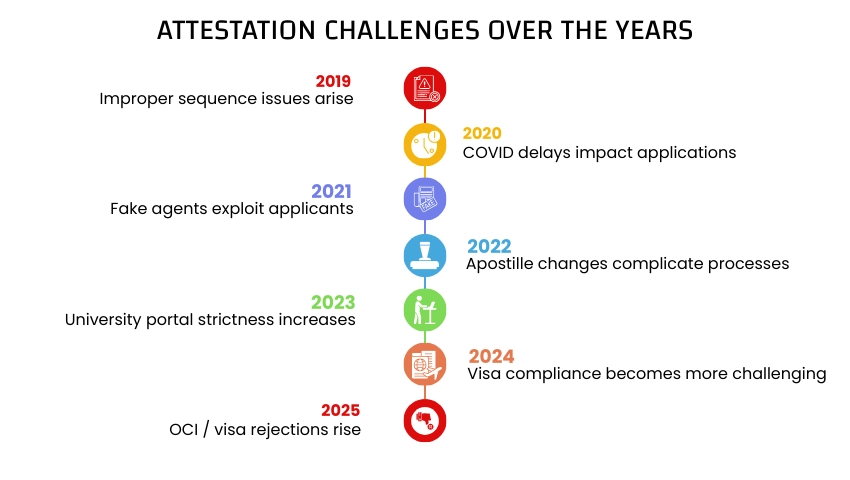
Common Problems Applicants Face Year by Year
From 2019 to 2025, attestation complexity increased due to fraud controls, digitization changes and evolving apostille rules:
| Year | Key Issue Reported | Impact on Applicants |
|---|---|---|
| 2019 | High rejection due to improper attestation sequence | Moderate delays |
| 2020 | COVID disruption delays in MEA/Embassy processing | Major backlogs |
| 2021 | Increased fraud & fake attestation agents reported | Legal obstacles |
| 2022 | Changes in apostille acceptance in some countries | Confusion for students |
| 2023 | University portals strict scanning/self attestation norms | Reuploads needed |
| 2024 | Work & education visa changes require apostille compliance | Application rejection |
| 2025 | OCI & visa apps reject docs w/o apostille in India/US | High rejections |
This year by year snapshot highlights the upward trend of attestation requirement complexity and document loss impact.
What if my documents are damaged (Water-logged or Torn)?
Damaged documents are often treated the same as lost ones if the seal or signature is illegible.
Don't Laminate: If the document is damp, do not laminate it. Lamination is rejected by many embassies (like the UAE) because they cannot place a wet-ink stamp on plastic.
Surrender & Replace: If the serial number is visible, take the damaged document to the issuing authority. They may issue a replacement faster if you "surrender" the damaged one.
.webp "If Your Attested Documents Are Lost or Damaged, What to Do")
Re-Attestation Steps for Lost or Damaged Certificates
To legally validate lost or damaged attested certificates, you must complete the full re-attestation process. This involves verification at multiple levels, starting from the issuing authority to international legalization by embassies.
• University/Board Verification: The issuing university or board authenticates the duplicate certificate to confirm its originality.
• State HRD/Home Dept: The state authority validates the certificate for local and national recognition.
• MEA Attestation: The Ministry of External Affairs provides central government attestation for international use.
• Embassy Legalization: The foreign embassy or consulate completes final legalization, making the certificate acceptable abroad.
Use DigiLocker and Genuinity Certificates for Faster Verification
DigiLocker: Store your duplicate attested certificates in DigiLocker, a government-verified digital vault. This allows universities to verify your duplicates faster and provides a secure copy for MEA and embassy attestation.
Genuinity Certificate: Some countries require a Genuinity Letter from the university along with the duplicate certificate. Request this letter when applying for the duplicate to streamline verification with universities, the MEA and foreign embassies.
Document-Specific Recovery Plans: A Professional Roadmap
When you lose a document, there is no "one size fits all" solution. In 2026, the recovery process is highly specialized based on the nature of the document. To overcome these hurdles without wasting weeks of time, follow these specific recovery plans tailored to your needs.
(A) Educational Certificates (Degrees, Marksheets, Transcripts)
These are your most sensitive documents because they are the foundation of your visa or employment. The "Duplicate" must be treated with the same legal gravity as the original.
• Step 1: The Legal Shield (Police FIR/Loss Report): This is non-negotiable. Universities will not process your application without a formal police record. This proves the loss was genuine and prevents your old certificate from being used for identity fraud.
• Step 2: Institutional Application: You must apply directly to your University or Board.
o Expert Note: In 2026, most universities require a "Genuinity Check" during this phase. Be prepared for a "Search Fee" that varies depending on how many years ago you graduated.
• Step 3: The Re-Attestation Cycle: This is where most people get overwhelmed. A duplicate is a "new" legal entity. You must repeat the entire chain:
1. University Verification: The registrar confirms the duplicate is authentic.
2. State HRD Verification: The state education department authenticates the university's seal.
3. MEA/Apostille: The central government grants international validity.
4. Embassy/Consular Attestation: The final gatekeeper for your destination country.
(B) Personal Documents (Birth & Marriage Certificates)
Losing these can stall family visa applications or permanent residency. Unlike degrees, these are often held at the Municipal or Registrar level.
• The Recovery Path: Start with a Police Loss Report (some states now allow an "Online Lost Property" report for personal documents).
o Issuing Authority Request: Visit the Municipal Corporation or the Sub-Registrar office where the event was originally recorded.
o The Digital Advantage: In 2026, many of these are digitized. If your record is found in the central database, getting a fresh "Certified Copy" is significantly faster than recovering a degree.
Re-Attestation: These must be attested by the Home Department (instead of HRD) before moving to the MEA and Embassy.
(C) Legal & Commercial Documents (POA, Contracts, Affidavits)
Commercial documents like a Power of Attorney (POA) or corporate contracts carry massive financial liability. If these are lost or damaged, the recovery is more complex.
• Certified Copies from the Registrar: If the document was registered (like a property deed or a long-term POA), you must apply for a "Certified Copy" from the Sub-Registrar’s office where it was signed.
• Fresh Notarization: A photocopy of a POA is useless in court or for a bank. You must have the certified copy freshly notarized.
• Fresh Attestation Channels: For commercial use abroad (e.g., opening a branch office), the document often needs Chamber of Commerce attestation before the MEA and Embassy will touch it.
Why Voltech HR Services is Your Trusted Partner
.webp "If Your Attested Documents Are Lost or Damaged, What to Do")
Losing attested documents can delay employment, higher education and visa processing. Voltech HR Services provides end-to-end support, including newspaper notice guidance, university coordination and verification tracking, to ensure certificates are re-attested efficiently and without delays.
How Voltech HR Services properly handles your attestation:
Topical Authority: With over 15 years of experience and MOIA-certified & ISO processes, we know the exact requirements for every major embassy in 2026.
End-to-End Solutions: We don't just stamp papers; we guide you through the FIR, the newspaper ads and the university coordination.
Safety & Transparency: Your new original documents are handled under strict tracking protocols. We provide 24/7 status updates so you are never in the dark.
Voltech HR Services coordinates university verification, duplicate certificate processing, HRD/Home Department validation, MEA attestation and embassy legalization to ensure lost documents are legally re-attested with minimal delays.
FAQs:
Q1: Will the police arrest me if I report my certificates as lost?
Reporting a lost document is a civil matter. The police will issue a Non-Traceable Certificate, which is required to apply for a duplicate from your university.
Q2: Will my company take action if I lose my certificates?
Industry estimates indicate that approximately 90% of employers allow a 30–60 day grace period for re-attested documents. FIR copies, duplicate application receipts, or a Processing Letter can be submitted as interim proof.
Q3: Will losing my documents abroad affect my visa or residency?
Losing attested certificates does not invalidate your visa or passport. Attested documents are only required for specific processes, such as labor card renewals or sponsorships. Contact your home country embassy for verification or duplicate attestation guidance.
Q4: What is the first step after losing a certificate?
• Check all personal belongings for the missing certificate.
• File a Lost Document Report / FIR at the local police station (or online).
• Contact your university’s Examination/Records Wing for duplicate certificate requirements.
• Publish a newspaper advertisement if required by the issuing authority.
Q5: Will my office fire me because I lost my certificates?
Employment depends on your qualifications, not the physical certificate. Provide verification letters or scans to your employer to maintain compliance while re-attestation is in process.
Q6: Can I just give a photocopy while waiting for the duplicate?
Photocopies are only acceptable for internal office records. For visa or government submissions, a fully attested duplicate original is required.
Q7: How do I complete the attestation process for working abroad?
To work abroad, ensure your certificates are fully attested by your university/board, State HRD/Home Department, MEA and the destination country’s embassy. For a detailed guide, see our Complete Guide to Document Attestation for Working Abroad 2026.
.webp "If Your Attested Documents Are Lost or Damaged, What to Do")
Author Bio & Capability:
Author: [Venkat, Senior Attestation Executive at Voltech HR Services]
Hi, I’m Venkat. I’ve been working in the attestation and overseas documentation field for over 5 years now. In that time, I’ve personally handled 10,000+ certificates for students and professionals heading to the Middle East, UK and other countries - without compliance issues. I’ve seen what happens when documents are lost, delayed or rejected and I wrote this guide to help you avoid panic, save time and get things done the right way. Everything shared here comes from real cases I deal with every day.
Subscribe for latest update

Write Comment