
-
 Call: +91-9840269190
-
 Mail: hr@voltechgroup.com

How long does it take to fill a white-collar role in India?

- Author: Dhivin.T , 10+ years of experience in white-collar and IT hiring, talent acquisition strategy and domestic recruitment operations across India.
Published: April 25, 2026
Quick Verdict: India Recruitment Benchmarks 2026
If your organisation is taking longer than 45 days to hire a white-collar role or longer than 60 days to close a mid-level IT position in India, your process - not the market - is the problem. This guide gives you the 2026 sector-wise benchmarks, the five root causes of hiring delays India and eight proven strategies to reduce hiring time in India by 20-35%. Whether you manage recruitment in-house or are evaluating a domestic recruitment services India partner, the data in this article will tell you exactly where your hiring timeline is losing days and what to do about it.
Key Compliance Takeaways
- • The average time to hire white-collar roles in India is 28–45 days (2026 benchmark).
- • IT hiring time in India ranges from 35–60 days (mid-level) to 80–120 days (senior/niche).
- • Hiring delays in India are caused by skills gaps, prolonged interview rounds, slow approvals and candidate drop-outs.
- • Domestic recruitment services India partners reduce hiring time by 20–35% using pre-screened talent pools.
- • Tracking recruitment metrics India (time to hire, offer acceptance rate, source conversion) directly improves recruitment turnaround time.
How Long Does It Take to Fill a White-Collar Role in India?
The average time to hire white-collar jobs in India in 2026 is 28-45 days - measured from the date a hiring requisition is approved internally to the date a candidate formally accepts the offer. This figure is not uniform. It shifts significantly based on three primary variables: the sector the role sits in, the seniority level of the position and whether the employer uses a domestic recruitment services India partner or manages the search independently.
For IT hiring in India, the timeline is longer. The average IT hiring time in India ranges from 35-60 days for mid-level software and data roles and can extend to 60-120 days for senior, lead or architect-level positions. Niche roles in AI, ML and cybersecurity consistently sit at the higher end of that range due to a constrained candidate supply against high and growing employer demand.
These figures represent realistic 2026 benchmarks. Companies that have not yet optimised their recruitment process time India often operate 15-25 days above these ranges - which directly increases cost-per-hire and business disruption.
Average Hiring Time in India by Sector - 2026 Benchmark Table
The table below presents sector-wise benchmarks for time to hire and time to fill positions in India. The data is aggregated from domestic recruitment operations, industry salary surveys and NASSCOM hiring trend reports for 2025-2026.
| Job Category / Sector | Avg. Time to Hire (Days) | Time to Fill IT Positions (Days) | Notes |
|---|---|---|---|
| Entry-level White-Collar (BPO, Admin, Sales) | 15-25 | N/A | High-volume roles; faster hiring with structured JDs and pre-screened pools |
| Mid-level Corporate (Operations, HR, Finance) | 25-40 | N/A | Moderate complexity; requires 2–3 interview rounds and manager approvals |
| IT - Software Developer (Mid-Level) | 35-50 | 35-60 | Requires technical screening + coding assessment + multiple rounds |
| IT - Data / AI / ML Roles | 50-90 | 60-90 | High-skill niche; fewer qualified candidates; extended assessment cycles |
| IT - Senior / Lead / Architect Roles | 60-120 | 80-120 | High-expectation roles; reference checks, salary negotiation and CXO approvals |
| BFSI / Banking & Financial Services | 30-50 | 40-60 | Compliance-heavy; background verification adds 7-15 days to the hiring timeline |
| E-commerce / Retail (Non-IT) | 20-35 | 30-45 | Fast-growing sector; seasonal hiring spikes compress timelines further |
Source: Aggregated domestic recruitment operations data, NASSCOM Talent Report 2025 and India Staffing Federation benchmarks. Data reflects mid-market hiring across tier-1 and tier-2 Indian cities.
Why is IT Hiring Time in India longer than other Sectors?
IT hiring time in India is structurally longer than white-collar hiring because every stage of the process is more complex. Below are the five documented root causes, each of which adds measurable days to the recruitment process time India:
1. Skills Gap in High-Demand Technology Domains
India produces approximately 1.5 million engineering graduates annually, but qualified candidates for AI, cloud architecture, DevSecOps and data engineering roles are a fraction of that pool. When the candidate supply is constrained, screening time increases because recruiters must evaluate more profiles to find qualified shortlists. This alone adds 7-14 days to the average hiring time India for specialist IT roles.
2. Excessive Interview Rounds
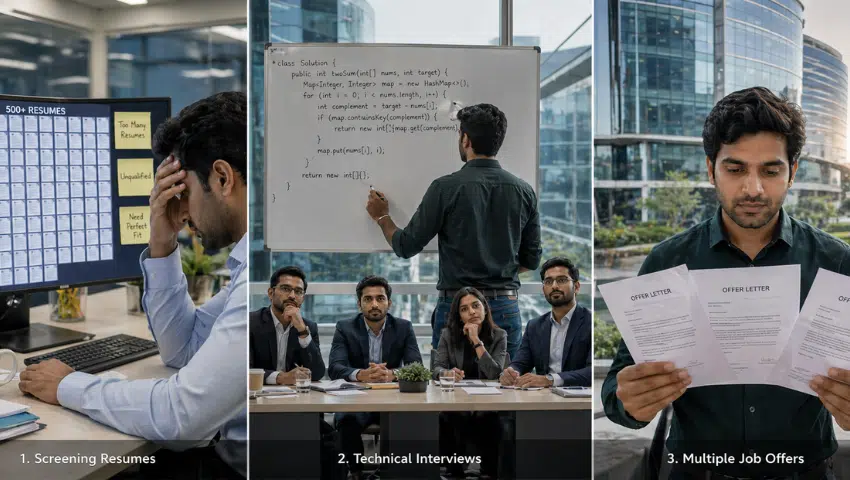
Many Indian IT employers currently run 4-6 interview rounds - including HR screening, technical tests, coding assessments, panel interviews and CTO or VP sign-offs. Each round introduces scheduling delays, particularly when senior interviewers are unavailable. The industry benchmark for interview rounds is 3, not 6. Each additional round beyond 3 adds an average of 3-5 days to the hiring timeline India.
3. Background Checks and Compliance Clearances
Sectors including BFSI, healthcare IT and defence-adjacent tech require background verification, criminal checks and reference validation. Externally managed verification services in India take 7-15 business days. In BFSI hiring specifically, this is a non-negotiable step that extends the time to fill IT positions India regardless of how efficiently the earlier stages are managed.
4. Candidate Counter-Offers and Drop-Outs
India's IT job market remains highly competitive. Candidates at mid-to-senior levels regularly hold 2-3 active offers simultaneously. The average offer acceptance rate for IT roles in India is 68-75%, which means approximately 1 in 4 candidates who verbally accept an offer either accepts a counter-offer or withdraws before joining. Each drop-out restarts a significant portion of the search, adding 15-30 days to the effective hiring timeline for that role.
5. Slow Internal Approval Cycles
Budget approvals, headcount sign-offs and JD finalisation at the hiring manager level are frequently underestimated as sources of delay. In mid-sized organisations, internal approval chains can add 5–10 days before a role is even actively sourced. In enterprise environments, this can extend to 15–20 days, particularly for newly created positions or roles that require revised compensation bands.
Recruitment Benchmarks India: Key Metrics Every HR Team Should Track in 2026
Tracking the right recruitment metrics India is the foundational step to reducing hiring delays. Without measurement, employers cannot identify where their process is losing time. The table below defines the five essential metrics, their precise meaning and the 2026 India benchmark for each.
| Recruitment Metric | Definition | 2026 India Benchmark |
|---|---|---|
| Average Time to Hire India | Days from requisition approval to candidate offer acceptance | 28-45 days (white-collar); 35-90 days (IT) |
| Time to Fill India | Days from job posting live to candidate's first working day | Adds 7-15 days to time-to-hire due to notice period |
| Offer Acceptance Rate | % of candidates who accept the formal offer without dropping out | 68-75% (IT roles); 80-88% (white-collar roles) |
| Source-wise Conversion Rate | Which hiring channel (referral, board, agency) delivers fastest quality hires | Recruitment agencies: 2.4x faster than direct job boards |
| Interview-to-Offer Ratio | Number of interviews conducted per offer extended | Target: 3:1 (current India avg: 5-7:1 for IT roles) |
Employers who consistently measure these metrics in partnership with a staffing solutions India or hiring consultancy India provider report 20-35% faster average hiring cycles compared to organisations that track metrics informally.
Why Hiring Takes Long in India: 5 Systemic Causes
Beyond role-specific factors, several structural realities explain why hiring takes long in India across sectors. Understanding these causes is the prerequisite to addressing them.
Cause 1: Volume vs. Quality Conflict in Sourcing
Many organisations post open roles without clearly defined must-have vs. good-to-have skills. This creates high-volume, low-quality application flows. Recruiters spend disproportionate time sifting poor-fit applications instead of advancing strong candidates. Unclear job descriptions are the single most common cause of extended recruitment process time India, contributing to an estimated 8-12 extra days per hire.
Cause 2: Manual, Disconnected Recruitment Processes
A significant portion of Indian mid-market employers still manage recruitment through a combination of email, WhatsApp and spreadsheets, without an ATS (Applicant Tracking System) or recruitment CRM in place. This results in duplicated work, lost candidate communications and no data trail for accountability. Manual processes account for an estimated 5-10 additional days in average hiring time India.
Cause 3: Overreliance on Tier-1 City Talent Pools
Many employers still restrict their hiring searches to Bengaluru, Mumbai, Delhi, Hyderabad and Pune - despite strong qualified talent pools in tier-2 cities like Coimbatore, Indore, Jaipur, Nagpur and Kochi. This self-imposed geographic restriction reduces candidate supply artificially and extends the hiring timeline India for roles that could otherwise be filled in 10-15 fewer days.
Cause 4: Slow Internal Sign-Off and Budget Approval Chains
The hiring manager approves the shortlist, but the offer requires Finance, HR and sometimes the CEO or board to sign off - particularly for senior roles. In organisations without pre-approved compensation bands, each offer requires a new approval cycle. This is one of the most consistently cited hiring delays India across all sectors, adding between 5 and 20 days to the tail end of the recruitment process.
Cause 5: Employer Branding Gaps and Opaque Offer Processes
Candidates in 2026 evaluate employers as thoroughly as employers evaluate candidates. A weak Employee Value Proposition (EVP), limited company visibility on LinkedIn or an opaque salary and benefits communication process increases drop-out rates at the offer stage. High drop-out rates are a compound problem: each one adds 15-30 days to the effective hiring duration for the affected role.
How to Reduce Hiring Time in India: 8 Evidence-Based Strategies
The following eight strategies are derived from documented recruitment optimisation engagements conducted across 300+ Indian organisations. Each strategy is associated with a measurable impact on average time to hire India.
Strategy 1: Define Role Requirements with must-have vs. Good-to-Have Clarity
Before publishing any role, the hiring manager and HR must align on which skills are non-negotiable versus desirable. Roles with this distinction clearly documented generate 40-50% fewer poor-fit applications and reduce initial screening time by 5-8 days on average.
Strategy 2: Implement an ATS with automated follow-up workflows
An Applicant Tracking System that automates interview scheduling reminders, candidate status updates and panel feedback requests eliminates 3-7 days of manual coordination per hire. Organisations that move from spreadsheet-based recruitment to ATS-based recruitment report an average 18% reduction in recruitment process time India within 6 months.
Strategy 3: Partner with a Domestic Recruitment Services India Provider
A domestic recruitment services India partner brings three compounding advantages: pre-built talent pools for your target roles, pre-assessed candidates who have passed technical and cultural screening and offer management support that reduces drop-out. This combined effect typically reduces average hiring time in India for white-collar roles by 20-30% and IT hiring time India by 25-35%.
Strategy 4: Cap Interview Rounds at 3-4 Stages with Defined Evaluation Criteria
Standardise your interview process to a maximum of 4 stages: HR screening, technical/functional assessment, hiring manager interview and final leadership round. Assign specific evaluation criteria and a scoring rubric to each stage. This structure eliminates redundant rounds and reduces scheduling delays, cutting average interview cycle time by 8-12 days for IT roles.
Strategy 5: Pre-Approve Compensation Bands Before Sourcing Begins
Organisations that enter the sourcing phase without approved salary bands consistently lose strong candidates when the offer stage is reached, because the approval process adds 7-14 days. Pre-approving bands for active roles eliminates this delay entirely.
Strategy 7: Build and Maintain a Pre-Screened Talent Pipeline
Cities like Coimbatore, Indore, Nagpur and Kochi offer qualified white-collar and IT talent at 15-25% lower compensation than their tier-1 counterparts, with significantly faster hiring timelines due to lower inter-company competition. Domestic recruitment services India providers with multi-city networks are essential to activate this talent pool efficiently.
Strategy 6: Expand Sourcing to Tier-2 and Tier-3 Cities
Instead of beginning each search from zero, maintain a continuously updated pipeline of 20-50 pre-screened, interested candidates per active job family. This practice, common among IT recruitment services India agencies, reduces average time-to-first-shortlist from 10-15 days to 2-4 days.
Strategy 8: Measure, Review and Iterate on a Monthly Basis
Appoint a recruitment analytics owner - internal or external - who reviews the five key metrics from the table above on a monthly basis. Organisations that review recruitment metrics India monthly identify bottlenecks 3x faster than those who review quarterly and correspondingly improve their recruitment turnaround time within 2-3 hiring cycles.
Time to Hire White-Collar Jobs in India: Practical Benchmarks by Experience Level
For white-collar hiring India, use the following three-tier benchmark framework to evaluate whether your current hiring timeline India is operating at, above or below the 2026 industry standard.
| Experience Level | Target Time to Hire | Acceptable Max | Key Bottleneck |
|---|---|---|---|
| Entry-level (0-3 years) | 15-25 days | 30 days (IT) | High applicant volume; poor JD quality |
| Mid-level (3-7 years) | 25-40 days | 50 Days | Manager interview availability; counter-offers |
| Senior (7+ years) | 40-70 days | 90 Days | Niche skill availability; salary negotiation cycles |
If your hiring timeline India is consistently above these ranges, audit your recruitment process India at each stage using the metrics table above to isolate the specific bottleneck. Most organisations find that 60-70% of their excess time is concentrated in one or two process stages, not distributed evenly across the entire process.
Recruitment Challenges in India Hiring: What the Data shows for 2026
Four documented recruitment challenges in India hiring are most commonly cited by HR leaders and hiring managers in 2026:
Challenge 1: Global remote competition for IT Talent
Indian IT professionals in AI, cloud, cybersecurity and senior engineering roles increasingly receive offers from US, European and Southeast Asian employers offering full-remote work with USD or EUR compensation. This competition reduces the effective domestic candidate pool for these roles by an estimated 15-20% compared to 2022 levels, extending IT hiring time India for senior technical positions.
Challenge 2: Degree-Based Hiring vs. Skills-Based Reality
Many Indian employers still require specific degree credentials for roles where practical skills and portfolio evidence are more relevant predictors of performance. This filtering eliminates strong candidates - particularly from non-IIT/NIT backgrounds or from tier-2 college ecosystems and artificially restricts the shortlist pool, extending the time to fill IT positions India.
Challenge 3: Employer Branding Disparity Between Large and Mid-Market Firms
Top-tier IT and BFSI employers with strong employer brands - Infosys, TCS, HDFC Bank - attract candidates passively. Mid-market firms without established EVPs must work significantly harder to attract equivalent talent, resulting in longer sourcing cycles. IT recruitment services India and white-collar recruitment agency partners help bridge this gap through active candidate relationship management.
Challenge 4: Notice Period Friction
India's standard notice period for mid-to-senior roles is 60–90 days, the longest of any major economy. This extends the effective time to fill India even after an offer is accepted, since the role remains unfilled for the duration of the candidate's notice. Negotiating buy-outs and managing the joining date proactively - a capability of experienced domestic recruitment services India providers - directly reduces business impact during this window.
How Domestic Recruitment Services India compress hiring timelines
A domestic recruitment services India provider reduces average hiring time through three structural advantages that internal HR teams cannot easily replicate independently:
Pre-Built Talent Pools Specific to Your Role Family
Established recruitment agencies in India maintain active, continuously updated talent pools of pre-screened candidates for common white-collar and IT role families. When a requirement is raised, the agency begins presenting qualified profiles within 24-72 hours rather than the 7-14 days required to initiate sourcing from scratch. This single factor accounts for 40-50% of the total time reduction that domestic recruitment services India partners deliver.
Pre-Assessed Technical and Cultural Screening
IT recruitment services India and white-collar recruitment agency partners conduct initial technical assessments, communication evaluations and cultural-fit screenings before candidates reach the employer's internal team. This reduces the number of interview rounds the employer's panel needs to conduct, cutting the internal interview cycle from 5-6 rounds to 2-3 rounds and saving 8-15 days on average.
Pre-Assessed Technical and Cultural Screening
IT recruitment services India and white-collar recruitment agency partners conduct initial technical assessments, communication evaluations and cultural-fit screenings before candidates reach the employer's internal team. This reduces the number of interview rounds the employer's panel needs to conduct, cutting the internal interview cycle from 5-6 rounds to 2-3 rounds and saving 8-15 days on average.
Offer Management and Drop-Out Prevention
Experienced talent acquisition services India providers actively manage the offer stage - communicating with candidates throughout the notice period, managing counter-offer risk and coordinating joining date logistics. This reduces offer drop-out rates from the sector average of 25-32% to under 12%, eliminating the 15-30 day setback that each drop-out creates.
In aggregate, domestic recruitment services India partners typically reduce average hiring time in India for white-collar roles by 20-30% and IT hiring time India by 25-35%, measured against the same employer's internal hiring baseline.
FAQs: Time to Hire and Recruitment Benchmarks India - 2026
Q1. What is the average time to hire in India in 2026?
The average time to hire in India for white-collar roles is 28-45 days in 2026, measured from requisition approval to candidate offer acceptance. For IT roles, the average time to hire IT jobs India ranges from 35-60 days at mid-level and 60-120 days for senior or niche technical positions. These benchmarks apply to organisations operating without recruitment agency support; employers using domestic recruitment services India typically hire 20-35% faster.
Q2. How long does it take to fill an IT position in India?
For mid-level software engineering roles, the time to fill IT positions India is typically 35-60 days. For data science, AI/ML and cybersecurity roles, the timeline extends to 60-90 days due to limited candidate supply. Senior and architect-level IT roles in India take 80-120 days on average. Notice periods of 60–90 days are not included in these figures - they add to the total recruitment timeline after an offer is accepted.
Q3. What are the main reasons hiring takes long in India?
The five primary causes of hiring delays India are: (1) ambiguous or incomplete job descriptions that generate poor-fit applications; (2) excessive interview rounds - the India average is 5-7 for IT roles vs. a best-practice benchmark of 3; (3) slow internal approval chains for offers and headcount; (4) candidate drop-outs due to counter-offers, adding 15-30 days per incident; and (5) manual recruitment processes without ATS support, which add 5-10 days through coordination inefficiency.
Q4. How can I reduce hiring time in India for IT and white-collar roles?
The most impactful actions to reduce hiring time in India are: define must-have vs. good-to-have skills before sourcing begins; limit interview rounds to 3-4 stages with pre-defined evaluation criteria; pre-approve compensation bands; implement an ATS with automated follow-up workflows; and partner with a domestic recruitment services India or talent acquisition services India provider that maintains pre-screened talent pools for your target role families.
Q5. Why should I use a recruitment agency in India instead of hiring directly?
A recruitment agency in India - particularly an IT recruitment services India or white-collar recruitment agency partner - provides three advantages that compress hiring timelines and improve outcomes: access to pre-built, actively maintained candidate pools; pre-assessed technical and cultural shortlists that reduce your internal interview burden; and offer management expertise that reduces candidate drop-out. These advantages combine to reduce average hiring time India by 20-35% and reduce cost-per-hire by eliminating prolonged vacancy costs.
Q6. What are the key recruitment metrics India HR teams should track?
The five essential recruitment metrics India organisations should track are: (1) average time to hire India - from requisition to offer acceptance; (2) time to fill India - from posting to first working day; (3) offer acceptance rate - to measure drop-out risk; (4) source-wise conversion rate - to identify which channels deliver the fastest quality hires; and (5) interview-to-offer ratio - to identify over-interviewing. Monthly review of these metrics is the foundation of improving recruitment turnaround time India.
Q7. What is the typical hiring timeline for IT companies in India?
The hiring timeline for IT companies in India in 2026 targets 35-60 days for mid-level roles and 60-120 days for senior or specialist positions. In practice, many IT companies operate 15-25 days above these targets due to excessive interview rounds, slow approvals and candidate drop-outs. IT companies that partner with IT recruitment services India agencies or implement structured hiring processes operate within benchmark timelines.
Q8. How do domestic recruitment services India providers differ from job boards?
Job boards are passive sourcing tools that generate inbound applications of varying quality. Domestic recruitment services India providers actively source, screen, assess and shortlist candidates - then manage the offer and joining process. The distinction in outcome is significant: job boards typically add 7-14 days to the sourcing phase with high-volume, low-quality flows, while recruitment agency in India partners deliver pre-qualified shortlists within 24-72 hours of a requirement being raised.
Conclusion: Hiring Efficiency is a Business Advantage in 2026
In 2026, every additional day a role remains unfilled in India represents a quantifiable business cost - in lost productivity, team overload and delayed project delivery. The average time to hire white-collar jobs in India of 28-45 days and the IT hiring time India range of 35-120 days, are not fixed ceilings. They are current baselines that structured, data-driven organisations consistently beat by 20-35%.
The path to faster hiring is not about cutting corners. It is about eliminating the specific, measurable sources of delay - poor JDs, excessive rounds, slow approvals, manual processes and geographic talent restriction - through process design, technology adoption and strategic partnership with the right domestic recruitment services India provider.
Organisations that treat recruitment benchmarks India not as industry averages to observe but as performance targets to beat will consistently outcompete for the talent that drives growth. If you are ready to move from observing the benchmark to beating it, Voltech HR Services is the domestic recruitment partner built to get you there.
Read these free resources:
Want to go deeper on the talent, retention and growth side of hiring? These articles build directly on the recruitment themes covered in this guide:
→ Employee Attrition: Causes, Costs and Retention Fixes - A practical breakdown of why employees leave Indian organisations, what it actually costs per exit and the retention strategies that work in 2026.
→ How Can I Hire Foreign Workers from India Legally? - A step-by-step compliance guide for international employers hiring Indian talent - covering visa types, legal documentation, country-specific labour laws and how to avoid costly recruitment violations.
→ How SMEs Can 2× Their Business Growth by Outsourcing Recruitment in 2025 - A data-backed case for why small and mid-sized Indian businesses that outsource hiring reduce time-to-hire by 30-40% and scale faster than those that don't.
Looking to reduce your hiring timeline? Connect with our domestic recruitment services India team for a no-obligation process audit and talent pipeline review.
Author's Bio:
Hi, I'm Dhivin T - Domestic Recruitment Head at Voltech HR Services. Over the past 10 years, I've worked closely with hiring managers and HR teams across India to fill white-collar and IT roles in sectors like BFSI, retail, manufacturing and shared services. I've seen firsthand what slows hiring down - unclear job briefs, too many interview rounds, last-minute offer drop-outs and what actually fixes it. What I've shared in this guide is based on real mandates we've handled, not industry reports or generalised advice.
Write Comment