
-
 Call: +91-9840269190
-
 Mail: hr@voltechgroup.com

Employment Verification in India: What Employers Check and Common BGV Discrepancies

Employment Verification in India: What Is Checked and Why It Matters
- By Jagannathan
- Published: [21.09.2026]
- Updated: [21.09.2026]
- Written by Jagannathan , Head - Background Verification Services | Voltech HR Services | 7+ years overseeing employment, education and criminal-record verification for employers across India.
Key Takeaways - Quick Reference
What Is Employment Verification in India?
Employment verification is one of the most relied-upon components of a background verification (BGV) check in India. It helps organizations validate the employment information a candidate has provided before a final hiring or onboarding decision is made. A verification exercise typically goes beyond a simple "did this person work here" confirmation - depending on the scope agreed with the employer, it can cover employment dates, designation, salary-related details, supporting documents, and other employment parameters.
This article explains what employment verification actually checks, how discrepancies are identified and handled, and what Voltech HR Services' own verification data shows about the frequency and nature of these findings.
Why Is Employment Verification Important for Employers?
Employers rely on employment verification because candidate-provided information, on its own, is not sufficient for a hiring decision that carries legal, financial, and reputational weight. Verification exists to:
What Does Employment Verification Check?
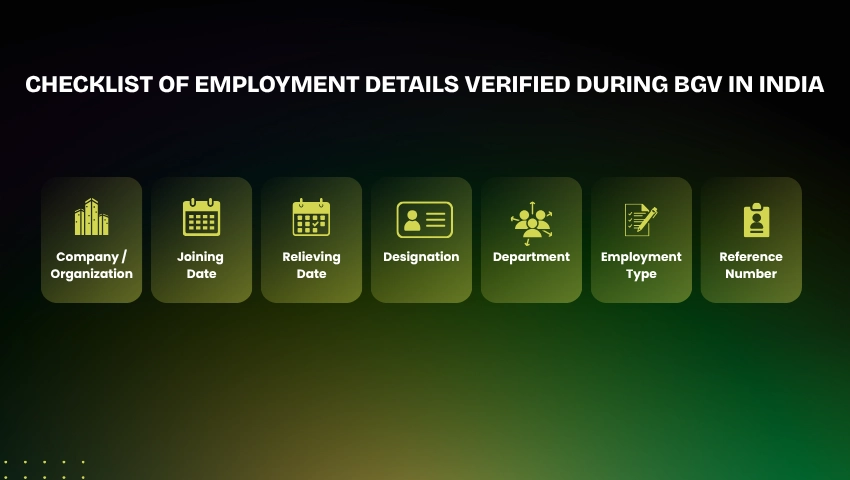
Employment verification typically examines a defined set of parameters agreed upon between the employer and the verification provider. These form the factual backbone of the check.
Employment Details
Under employment verification, the core employment-details check typically examines the following parameters:
What Employment-Related Information Can Be Verified?
Beyond core employment details like dates and designation, employment verification can also cover salary and payslip information, where these fall within the agreed verification scope. Salary verification compares the candidate's stated compensation against what is available from the verification source, while payslip verification checks whether the submitted payslip's salary figures, employment period, and employer details are consistent with available records.
Salary Verification
When salary verification is included in the BGV scope, Voltech's process specifically checks the following salary-related parameters:
Payslip Verification
Payslip verification is a document-level check that cross-references a candidate's submitted payslip against available employment records. Where it forms part of the BGV scope, the check assesses:
It's important to note that a payslip discrepancy is identified through this kind of cross-check against available records - it is not simply a subjective call of "this looks fake." The verification process documents where the submitted information does not align with what can be confirmed, and that finding is then reported for the employer's review.
What Employment Discrepancies Can Appear During BGV?
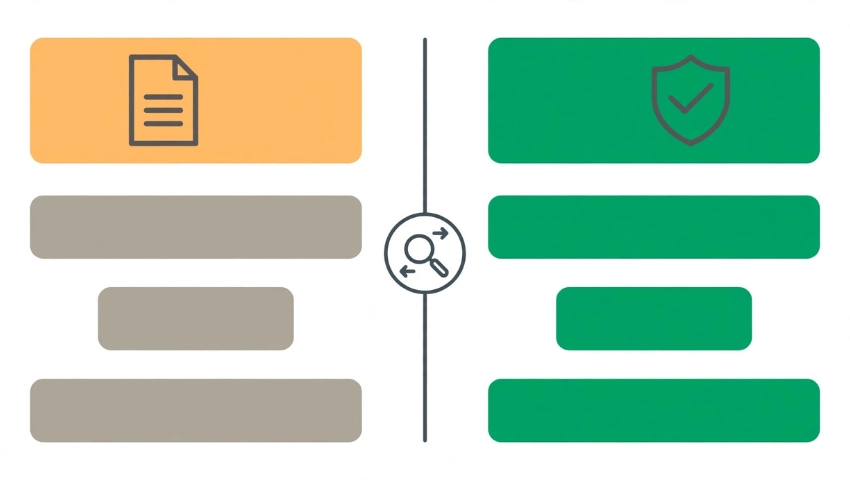
Employment discrepancies are differences between what a candidate has declared and what the verification process confirms with the previous employer. The most common types include employment date discrepancies (mismatched joining or relieving dates), designation discrepancies (a different job title than claimed), salary discrepancies (differences in stated versus verified compensation), and employment document discrepancies involving experience letters, relieving letters, payslips, or other supporting paperwork.
Employment Date Discrepancies
An employment date discrepancy occurs when the joining or relieving dates a candidate declares do not match the dates confirmed by the previous employer. For example:
Verified information: March 2021 - December 2024
Differences of this kind, whether at the joining date, the relieving date, or both, are recorded as part of the verification report and reviewed against the documentation and employer response available.
Designation Discrepancies
A designation discrepancy occurs when the job title a candidate declares does not match the title confirmed by the previous employer. For example:
Verified information: Senior Engineer
A designation mismatch is documented and assessed according to the verification parameters agreed with the employer, rather than treated as an automatic disqualifier.
Salary Discrepancies
A salary discrepancy arises from differences between the salary information the candidate has provided and the salary information available through the verification process - for example, through employer confirmation or payslip cross-checking.
Employment Document Discrepancies
Employment document discrepancies are inconsistencies found across the paperwork a candidate submits in support of their employment history. These can appear across several document types, including:
Can Previous Employment Performance Be Verified?
Some employers ask whether a previous organization's remarks on a candidate's performance or conduct can be obtained as part of employment verification. This is possible only to the extent that the previous employer chooses to disclose it. Depending on what the previous employer is authorized and willing to share, verification may capture:
It's important to set the right expectation here: not every previous employer's HR or compliance policy permits sharing performance-related remarks. What gets captured depends entirely on what the source organization is willing and able to disclose.
Can Employment Verification Check the Candidate's Reason for Leaving?
Yes, but this depends entirely on whether the previous employer chooses to disclose it. Where the employer provides this information, the verification may capture the stated reason for leaving, the exit status, and any other exit-related details the employer is willing to share. Not every employer discloses this as a matter of policy, so it should not be assumed to be available in every verification report.
Can Rehire Eligibility Be Verified?
Rehire eligibility, or rehire status, is another parameter that may surface during employment verification - again, only where the previous employer's records or response include it.
This, like the previous two sections, is disclosed at the discretion of the source employer and is not a guaranteed component of every check.
Can Full & Final Settlement Status Be Verified?
Yes, Full & Final (F&F) settlement status can be verified as part of employment verification, but only when it is included in the agreed verification scope. This check confirms whether the previous employer has completed the F&F process with the candidate, whether it is still pending, or whether the employer has provided any relevant confirmation on the matter. It is not treated as a default check that applies to every employment verification - it is carried out specifically when requested.
What Is Checked?
Depending on the verification requirement, this may involve reviewing whether:
How Are Employment Gaps Identified During BGV?
Employment gaps are identified by comparing the employment periods declared across a candidate's work history and looking for periods that are unaccounted for. For example:
Company B: January 2023 - Present
This creates a potential employment gap between July 2022 and December 2022 - a period that may require the candidate to provide clarification, whether that was a career break, further education, freelance work, or another reason.
What Happens When Employment Information Does Not Match?
A mismatch between candidate-provided information and verified information does not automatically mean fraud. The verification process is built to record and classify the finding, not to make an accusation. Possible outcomes include:
This distinction matters: treating every discrepancy as intentional falsification is inaccurate and can lead to unfair outcomes for candidates whose records simply reflect administrative differences - for example, a company's HR system recording a slightly different relieving date than the candidate remembers.
What Are the Common Negative Findings in Employment Verification?
Based on the categories most frequently seen during employment verification, common negative findings include:
Case Study: How an Employment Verification Report Uncovered a Fabricated Experience Letter
The following is a real employment verification case handled by Voltech HR Services, with identifying details of the candidate and employer removed to protect confidentiality. It illustrates how a structured verification process can surface issues that a manual document review would likely miss.
The Request
A client submitted a KYC-linked employment verification request for a candidate who had listed a mid-level managerial role at a trading firm, including an experience letter as supporting documentation.
What Our Verification Process Found
Cross-checking the submitted documentation against the stated employer's records and business registration details surfaced multiple inconsistencies:
The Outcome
Based on these findings, Voltech HR Services classified the employment claim as a major discrepancy and reported the complete findings back to the client within 8 days of receiving the verification request, giving them a clear, documented basis to make their hiring decision.
How Does Employment Verification Help Employers?
Validate Candidate Claims
Verification compares what the candidate has stated against what is available from the verification source, giving employers a factual basis rather than a self-reported one.
Identify Employment Discrepancies
It surfaces differences in dates, designation, salary, or documentation that warrant review before an offer is finalized or onboarding proceeds.
Support Consistent Hiring Processes
Using a defined set of verification parameters across all candidates helps employers apply the same standard consistently, reducing the risk of inconsistent or subjective hiring decisions.
Reduce Manual Verification Work
A dedicated BGV process manages employer outreach, follow-ups, documentation collection, and reporting - work that would otherwise fall on internal HR teams.
Employment Verification as Part of Background Verification
Employment verification is one component within the broader BGV process:
Employment verification sits within this sequence because it depends on candidate-submitted information being collected first, and it feeds its findings - including any discrepancies - into the final consolidated BGV report. Employment verification is one component of the broader BGV process, typically run alongside other checks such as education, address, criminal record, and reference verification, depending on the verification package an employer selects.
Frequently Asked Questions
Q1. What is checked in employment verification?
Employment verification typically checks the previous employer's name, dates of joining and relieving, designation, department, employment type, and employee reference number where applicable, depending on the agreed verification scope.
Q2. Can salary be verified during employment verification?
Yes, where salary verification is included in the scope. It compares the candidate's stated salary against information available from the verification source.
Q3. Can payslips be verified during BGV?
Yes, where payslip verification is part of the scope. It checks whether the submitted payslip's salary figures, employment period, and employer details are consistent with available records.
Q4. Can a previous employer verify the reason for leaving?
Only if the previous employer chooses to disclose this information. It is not guaranteed to be available in every case.
Q5. Can rehire eligibility be checked?
Yes, where the previous employer's records or response include rehire status, and where this falls within the agreed verification scope.
Q6. Can Full & Final settlement be verified?
Yes, where it falls within the agreed verification requirement. It checks whether F&F settlement was completed, is pending, or has been confirmed by the previous employer.
Q7. How are employment gaps identified?
By comparing employment periods declared across a candidate's work history to identify unaccounted-for time periods that may need clarification.
Q8. What happens if employment information does not match?
The finding is classified - verified, minor discrepancy, major discrepancy, requires clarification, or inconclusive - rather than automatically treated as fraud.
Q9. Does every employment discrepancy mean the candidate provided false information?
No. A discrepancy can result from administrative differences in records and does not, by itself, establish intentional falsification.
Q10. What are common negative findings in employment verification?
The most frequent categories are employment-date discrepancies, designation discrepancies, salary discrepancies, document discrepancies, employment gaps, and incomplete Full & Final information.
Related Resources for Employers & HR Leaders
Looking to strengthen your hiring and verification process? Explore our related guides:
→ Background Verification Services in India - Learn how Voltech HR Services runs identity, education, employment, criminal and reference checks as part of a complete BGV process for employers.
→ Recruitment Agency in India for Businesses - See how verified hiring fits into Voltech's end-to-end domestic and overseas recruitment process for employers.
→ Staffing & Payroll Services in India - Understand how compliant staffing and payroll processes reduce onboarding risk once a candidate clears verification.
Need reliable employment verification for your hiring pipeline?
Every unverified hire is a risk carried forward into your organization. Whether you need a single employment check or a complete background verification partner - Voltech HR has the team, the process and the 10+ year track record to deliver it accurately.
Tell us your verification requirement. Our specialist team will respond within 24 hours - no obligation, no hidden fees.
Write Comment