
-
 Call: +91-9840269190
-
 Mail: hr@voltechgroup.com

How to Choose Between Contract Staffing, Temporary Staffing and Permanent Recruitment

How to Choose Between Contract Staffing, Temporary Staffing and Permanent Recruitment
- By Muthamizh.P
- Published: 19 August 2026
- Last Updated: 19 August 2026
- Written by Muthamizh.P , I've been working in HR operations, payroll administration and statutory compliance for over 5 years. Through my work, I regularly advise business owners and HR leaders on choosing between contract staffing, temporary staffing and permanent recruitment based on project duration, budget structure, skill specialization and compliance ownership. The insights shared in this article are based on those conversations, industry practice and hands-on experience managing all three staffing models for clients across staffing and payroll operations in India.
Key Takeaways:
• Many businesses combine all three into a blended workforce model to balance cost control with operational flexibility.
Choosing between contract staffing, temporary staffing and permanent recruitment depends on three core factors: how long the role is needed, how specialized the skill set is and how much budget flexibility the business has. Getting this decision wrong is costly - either through unnecessary fixed overheads or repeated rehiring and onboarding losses.
This guide answers the questions business owners, HR managers and hiring leaders ask most when deciding between the three staffing models - with a clear decision framework, cost comparison and practical guidance for each scenario.
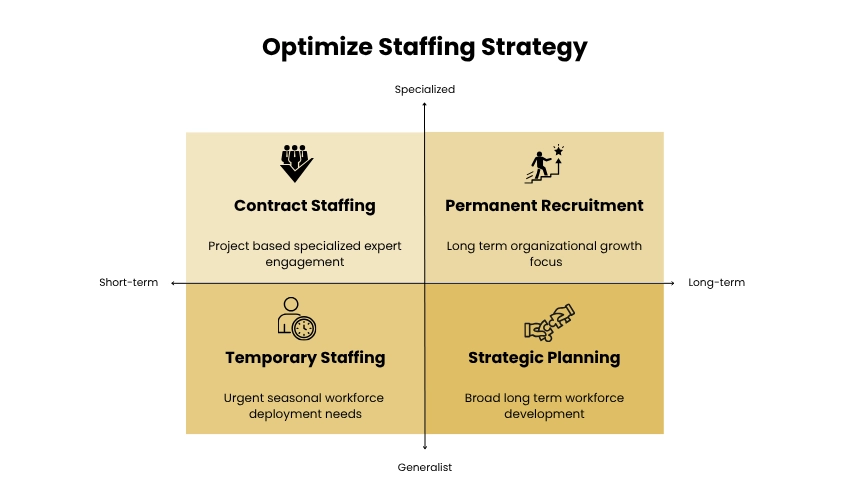
What Is Contract Staffing?
Contract staffing is a workforce model in which a staffing agency employs a professional and deputes them to work at a client company for a defined contract period, typically ranging from three months to two years. The staffing agency handles payroll, statutory compliance and benefits administration, while the client company directs the professional's day-to-day work.
Contract Staffing Is Commonly Used For
What Is Temporary Staffing?
Temporary staffing is a workforce model designed for short-duration needs, where an agency supplies workers to a business for a limited period - often days, weeks or a few months - without the expectation of long-term engagement. Temporary staff are typically deployed for operational, administrative or seasonal roles.
Temporary Staffing Is Commonly Used For
What Is Permanent Recruitment?
Permanent recruitment is the process of hiring a candidate directly onto a company's payroll for an indefinite, ongoing employment relationship. The employing company is fully responsible for the employee's compensation, benefits, statutory compliance, performance management and career development.
Permanent Recruitment Is Commonly Used For
Contract Staffing vs Temporary Staffing vs Permanent Recruitment: Key Differences
The table below compares the three staffing models across the factors that most directly affect a hiring decision.
| Factor | Contract Staffing | Temporary Staffing | Permanent Recruitment |
|---|---|---|---|
| Typical duration | 3 months – 2 years | Days – a few months | Indefinite / ongoing |
| Employer of record | Staffing agency | Staffing agency | Hiring company |
| Best suited for | Project-based or specialized skill needs | Short-term or seasonal coverage | Core, strategic or leadership roles |
| Compliance burden on employer | Low (managed by agency) | Low (managed by agency) | High (managed in-house) |
| Cost structure | Fixed contract rate + agency margin | Hourly/daily rate + agency margin | Salary + benefits + long-term overheads |
| Onboarding speed | Moderate to fast | Fast | Slower (full recruitment cycle) |
| Conversion to permanent role | Common ("contract-to-hire") | Less common | Not applicable |
How to Choose Between Contract Staffing, Temporary Staffing and Permanent Recruitment
Choosing the right staffing model requires evaluating the role against five decision factors: duration, budget, skill specialization, compliance responsibility and long-term workforce strategy. The framework below breaks down each factor and what it means for the final decision.
Assess Your Project Duration and Business Need
If the role exists to complete a specific, time-bound deliverable - a system migration, a marketing campaign, a compliance audit - the need has a natural end date, which points toward contract staffing. If the need is unpredictable and short, such as a sudden order spike or an employee's medical leave, it points toward temporary staffing. If the role will exist indefinitely and is core to ongoing operations, it points toward permanent recruitment.
Evaluate Budget and Cost Structure
Consider Required Skill Specialization
Highly specialized, in-demand skills are often more accessible through contract staffing, since professionals with scarce skills frequently prefer project-based engagements over long-term employment. Generalist, easily-trained roles are well suited to temporary staffing. Roles requiring deep, company-specific institutional knowledge are best filled through permanent recruitment.
Factor In Compliance and Employer-of-Record Responsibilities
Under both contract and temporary staffing models, the staffing agency acts as the employer of record, handling statutory compliance, payroll processing and benefits administration. This reduces the hiring company's administrative and legal burden. Under permanent recruitment, the hiring company assumes full employer-of-record responsibility, which requires internal HR and compliance infrastructure.
Weigh Cultural Fit and Long-Term Retention Goals
Roles where cultural alignment, succession planning and long-term institutional knowledge matter most should default to permanent recruitment. Roles where the business primarily needs output within a defined window, without long-term retention goals, are better served by contract or temporary staffing.
When to Choose Contract Staffing
Contract staffing works best when your business needs the right talent for a specific period, project or workforce requirement:
When to Choose Temporary Staffing
Temporary staffing is ideal when your business needs extra employees for a short period to manage changing or unexpected workforce demands:
When to Choose Permanent Recruitment
Permanent recruitment is ideal when your business needs long-term employees for critical roles that require stability, commitment, and continuous growth:
Cost Comparison: Contract vs Temporary vs Permanent Staffing
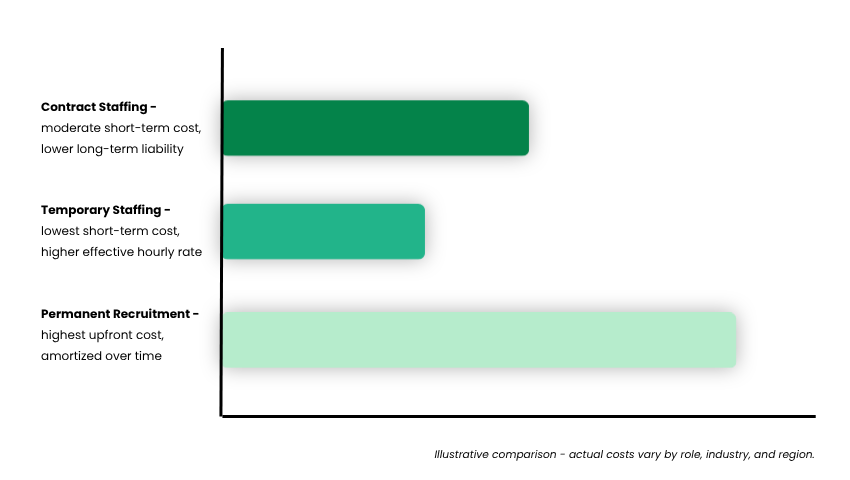
Cost comparison across staffing models should account for both direct and indirect costs, not just the visible rate or salary figure.
Common Mistakes to Avoid When Choosing a Staffing Model
How Can Voltech HR Services Help You Choose the Right Staffing Model?
Voltech HR Services supports businesses across India in evaluating, structuring and managing contract staffing, temporary staffing and permanent recruitment - as standalone models or as a blended workforce strategy.
| Service Area | What Voltech HR Does for You |
|---|---|
| Contract Staffing | End-to-end deployment of contract professionals with statutory compliance managed on your behalf. |
| Temporary Staffing | Fast-turnaround deployment for seasonal demand, leave coverage and short-term operational needs. |
| Permanent Recruitment | Full-cycle hiring for core, strategic and leadership roles across industries. |
| Payroll & Compliance Management | EPF, ESI, gratuity and statutory filing management across all staffing models. |
| Workforce Strategy Advisory | Assessment of your current workforce mix and recommendations for a blended staffing model. |
Which Staffing Model Is Right for Your Business?
There is no single correct staffing model - the right choice depends on the shape of the need in front of you. A short, defined project calls for contract staffing. A sudden, temporary gap calls for temporary staffing. A role that will define your business for years calls for permanent recruitment.
Most growing businesses end up using all three models at different points - the goal is not to pick one permanently, but to reassess the mix as project needs, budgets and growth stage evolve.
Frequently Asked Questions on Choosing a Staffing Model
Q1. Is contract staffing more expensive than permanent hiring?
Contract staffing can appear more expensive on a per-hour or per-month basis because the rate includes the staffing agency's margin. However, it often works out more cost-efficient overall for short-to-medium-term needs, since it eliminates long-term liabilities such as severance, benefits and retirement contributions that apply to permanent employees.
Q2. Can temporary staff be converted to permanent employees?
Yes. Many companies use temporary staffing as an informal trial period, and top-performing temporary workers are sometimes offered permanent roles. This is less common and less structured than "contract-to-hire," which is a more formal pathway typically built into contract staffing agreements.
Q3. Which staffing model is best for startups?
Early-stage startups often benefit from a blended approach: contract staffing for specialized project work, temporary staffing for short-term operational spikes and permanent recruitment reserved for core leadership and product roles where long-term continuity is critical.
Q4. How long can a contract staffing engagement last?
Contract staffing engagements typically range from three months to two years, though exact limits depend on local labor law and the staffing agency's agreement terms. Engagements exceeding this range are often restructured into permanent roles to remain compliant with local employment regulations.
Q5. Who handles compliance for contract and temporary staff?
The staffing agency acts as the employer of record for both contract and temporary staff, managing payroll, EPF, ESI and other statutory obligations. The hiring company directs day-to-day work but is not responsible for the underlying compliance filings.
Related Resources for Employers & HR Leaders
Looking to strengthen your staffing and compliance strategy in 2026? Explore our related guides:
→ Contract Staffing in India 2026 - HR & Business Guide - Understand the compliance framework and principal-employer liability rules that apply to every contract staffing engagement in India.
→ Staffing & Payroll Services in India to Avoid Compliance Risks - A closer look at how outsourced payroll and staffing management reduce statutory risk for growing businesses.
→ Global & Domestic Recruitment Agency in India - Learn how a trusted hiring partner supports permanent recruitment across industries and geographies.
Not Sure Which Staffing Model Fits Your Business?
Talk to our team for a free workforce assessment and get a recommendation tailored to your project timelines, budget and compliance needs.
www.voltechhrservices.comContract Staffing | Temporary Staffing | Permanent Recruitment | Payroll & Compliance
Write Comment